

The Aurorasound HFSA-02 integrated amplifier by David Abramson
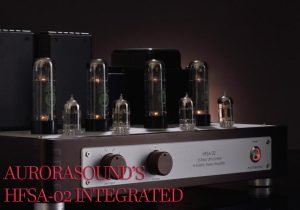
Aurora Borealis
 I’ve never heard a bad Aurorasound amp. Am I Experienced? Hell yes. I’ve heard exactly two of them, and whatever designer Shinobu Karaki is smoking and/or drinking, I think more designers should smoke and/or drink it. Matter of fact, with the new heads of the FDA, maybe it’ll all be approved soon! But by all means, let’s let Joe Rogan weigh in first…
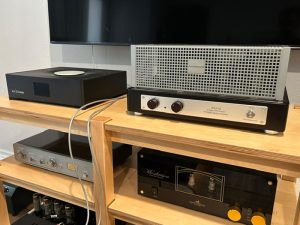
The Aurorasound HFSA-02 is a 44-pound, 30-watt-per-side EL34 tube integrated amp equipped with superb Lundahl transformers (just like my Shindo F2a amp) and is available either with a built-in MM phono stage for a few hundred bucks extra, or as a line-only unit replete with balanced (XLR) inputs (along with several RCA inputs). (No, it doesn’t seem to have balanced transformers, just the balanced input capability).
On its inlaid stainless-steel face, it has a volume control and an input selector. I’m told it also includes a nice remote control which, owing to Roon’s app-based digital volume control in conjunction with the analog volume control on my Grimm MU2 digital front end, I never touched.
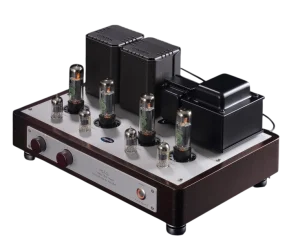
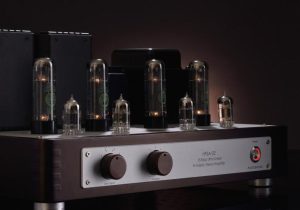
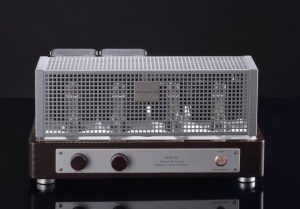
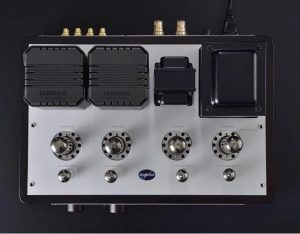
A pleasing circle of soft red light rings the power button when depressed, indicating the amplifier is ready to play. (Ok, maybe it’s not really ‘ready to play’ until 20 or 30 minutes or so of ‘on time’, but it’ll function as soon as you push ‘power’).
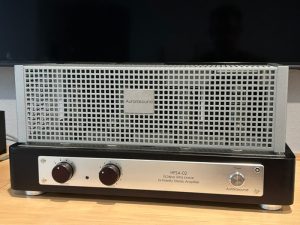
With its mesh grey mid-century esq tube cage (mercifully an easy-on, easy-off one) and its sleek brushed stainless front plate floating upon a dark stained wood base, the HFSA-02 brims with retro-modern appeal.
Per distributor Alfred Kainz, “The MM phono stage in the HFSA-01 and HFSA-02 is similar to the MM part in the VIDA Prima. If you want an MC system, you’ll need an SUT or an external phono stage like the VIDA Prima or the better one, the VIDA Mk.II, or any other brand. And they usually provide MM and MC inputs. Michael Lavorgna from Twittering Machines bought his review HFSA-02, and it seems it’s in his reference system now. He also uses the Aurorasound AFE-12 SUT for MC phono.”
Well, if Lavorgna bought the review unit, who am I to argue?! Wish I had a ‘barn’ of my own!
In all seriousness, Michael Lavorgna, Christiaan Punter and Wojciech Pacula are my three ‘go-to’ guys for all things audio, so if one of my big three bought his review sample? Sure. This I gotta hear…
Deployment
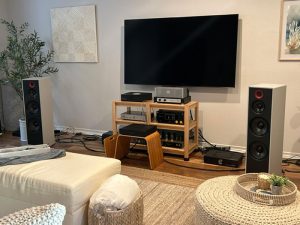
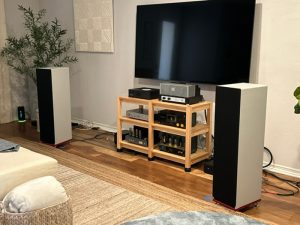
 I employed and deployed the Aurora with three sets of speakers: the Devore O/96, the Fleetwood Sound Company Helios, and the Stenheim Alumine 3. The Aurora had zero issues driving any of these well-regarded loudspeakers, and it may well have been a 150-pound pair of 300-watt mono blocks at the 68-72db average volumes (with maybe 88db peaks) at which I typically listen.
The source was the Dutch-Army-knife Grimm Audio MU2, and amplifiers included an Air Tight ATM-300R and the EL34-based ATM-1S, an Air Tight ATC-6 line preamp, a Shindo F2a Cortese amplifier with matching Monbrison preamplifier, and a Lejonklou Boazu 2.0 integrated amp rated for about the same power output.
Sporty Lincoln Ride (feat. Matthew McConaughey)
Right off the red-light jump with The Roger Kellaway Trio’s ‘Remembering Bobby Darin’, Matthew’s iconic ads are what the Aurora brought to mind. A big, slightly plush, effortless presentation, faintly warm but with excellent detail. Refined. Classy. A denim shirt, rich ‘Corinthian leather’ and a cigar, sure, but this is a modern sound- a sportier presentation like a Lincoln Aviator; at once familiar and comfortable, but with no nerf-safe tubey body roll. It’s got high torque and great tires; snap and dynamism.
With the Bill Charlap Trio’s 2021 album Street of Dreams streamed via Qobuz, the Aurora is taught, energized; magisterial. The stage is huge, and it’s populated by real-life people playing real-life-sized instruments. Via my O/96’s the scale is just awesome.
This is definitely high-end audio writ large, I thought to myself! To quote the Audiophilac from virtually every review he’s ever done of anything, “Wow– I mean, just wow!!” (Hey, I never plagiarize- I pay homage🙂 Steve Huff would buy the review sample right about now, and Jay’s Audio Lab would be waiting for the Aurora 400-watt Moo-in-o-blocks to arrive! “Guys! Guys! Wait till you see what’s coming to the lab!”
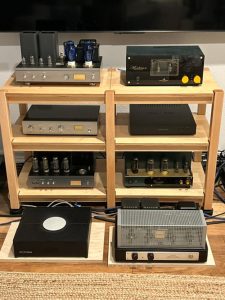
Yeah, the Aurora didn’t care one whit that much pricier gear was lurking all around it. No stage fright whatsoever. With a few exceptions, it performed on par with essentially all of it. This was indeed shocking and ‘wowing ’. It wasn’t just the scale and detail the Aurora conveyed, but the emotion behind it, perhaps even to a greater degree than some of its pricier stablemates.
I won’t apologize for not being able to quantify engagement, but like the HFSA-01, there is indeed a certain something ‘special’ about this one as well. It’s genuinely involving and toe-tapping. Perhaps it’s the uprated (SR Master) fuse they included in both my 01 and 02 units? If that’s partly responsible for its delectableness, then fuses all around, I say!
The antithesis of a syrupy tube cliche; it’s muscular and fast for its breed. After all, it’s solid-state rectified and has a solid-state preamp, so while not a hybrid amplification circuit per se, it’s hybrid by topological marriage. I think that’s still legal these days and, in the very best sense, it sounds like a beautiful union, seemingly embodying the best qualities of each.
I’d call it ‘linear tone’, for lack of a better phrase. If I had to pull from audio memory, I’d ballpark the Aurora as slightly warmer than, say, a Linear Tube Audio Berning-type amp, and slightly more linear/neutral than a Leben 600X (all of which I’ve owned at one time or another). In other words, fans of either the Leben or the LTA gear probably wouldn’t kick the Aurora out of bed, since it sits tonally smack between them.
Hitting the tone pipe
 My audio friend Jeff once said that if Leben is like snorting tone, Shindo is like sticking the needle directly into your vein. I don’t do drugs, but I have been known to mainline Shindo from time to time.
With a really well-known-to-us-all album like Bill Evans’ Waltz for Debby Live At the Village Vanguard/1961′ head-to-head via the Stenheim Alumine 3, the full boat Shindo is clearer-headed, more ‘lit up’, and a bit leaner. There is very slightly more separation and space around instruments. It is dead quiet electrically; the Shindo stack has the blackest of backgrounds, and this is more than I can say of my Air Tights or the Aurora, both of which show some transformer hum here in my space even when plugged into my Torus RM 15 isolation transformer.
This transformer hum was actually the case with both samples of the Aurora I received: the phono version and the line version. The HFSA-01 was dead silent, and any hum here with amps may be due to the less-than-stellar electricals in my 1990s condo in a densely populated area. Your mileage and all that…
In any case, this hum with my Air Tights and the Aurora is largely mechanical (i.e., coming from the transformer’s physical vibration), but it’s a bit audible at the amp if you’re a foot or so away. I don’t sit a foot or so away from my amps, or this would be a headphone review.
Back to the sound of music. Continuing, the Aurora is muscular, and the Shindo does its Shindo thing- quiet (savage?) beauty; mountain stream-like flow and superb clarity.
Now, the Aurora is beautiful, spacious, and powerful-sounding for a low-wattage amp, yes, but it’s not an 80-pound, 400-watt push-pull amp or even a 10-watt Air Tight 300R, whose massive transformers alone likely weigh more than the Shindo F2A!
I’m not scoring this one as it’s a preference thing; just telling it as I hear it. Head-to-head via my Devore O/96’s, with the mighty 300R and baritone Matthias Goerne singing lieder on his recent Schumann lieder album ‘Zwielicht’ the 300R with Linlai Sapphire 300B tubes or the slightly ‘purer’ Takatsukis (MSRP over 20K for the amp) presents as a bit weightier and denser with perhaps larger macro-dynamic swings, which is unexpected given its relatively low wattage, though very expected of its massive Tamura transformers and use with my high efficiency O/96 speakers.
However, with super virtuoso Marc Andre Hamelin’s wonderful Medtner piano sonatas album (all titles streamed via Qobuz), the Aurora is sweeping, expansive, and impactful, nipping at the well-heeled heels of the mighty 300R for half the MSRP.
The Aurora responded very well to some power cord switches like the addition of a Siltech Ruby II cord that cable wiz Rod left lying about here, and this particular cord took things even closer to the touch and tone of the pricier gear with the 96s (which are a bit forward-sounding in a drywall space like mine), though, to be fair, ultimately proved itself to be a bit too warm for use with the more tonally balanced and revealing Stenheim Alumine 3s.
Switching to the full-boat Shindo system adds a touch more texture, micro-dynamism, and tonal beauty without losing any scale or pace. Yes, at my typical modest levels- levels designed to mimic what I might hear during a piano recital in a small to mid-sized hall- you would absolutely not guess we just dropped down 20 or so watts to the 10-watt F2a amp.
The start-stop of the sonatas, the pregnant pauses, and the intention; the shaping of lyrical phrases are all slightly more apparent via the Shindo. (And your credit card bill would also be slightly more apparent at north of 30k MSRP for the full boat Shindo set-up I have here with cables and Mr T isolation transformer, etc.).
 ‘Donde hay Violencia; nay hay culpa’ is a well recorded two act Zarzuela written in 1744. Contrary to popular assumption, Taylor Swift didn’t write this; José de Nebra did.
Shortly after Shindo ignition, I texted my audio buddy, “already remarkable. I have to go pick up the food – [I had ordered Panang curry] … immediately more ‘air’ – some of the sinew is trimmed and replaced by more texture and air – the sound is ‘lighter’ and more buoyant. I’m back to the notion the Aurora is a Cadillac to the Shindo BMW. The BMW handles a bit quicker – a bit more resolved – like going to a silver IC from copper is the closest analogy, maybe…”
His response? “Makes complete sense…the F2a is a far faster circuit component than the EL34.” Amen. Yeah that.
I should add that, for full Shindo-fication, you’re looking at a NO JOKE 1 hour and 30 minute full warm-up time! So if you’re retired or don’t have kids, a dog, or any life-related responsibilities, no issue!
‘Jeez,’ I think to myself, as my partner bops around to Pink Pony Club on a JBL Bluetooth speaker right now on our kitchen countertop; “Hey- how long does THAT thing take to ‘warm up ’?!” Oy. What a pointless yet effortful hobby we have, I sometimes think.
Continuing the musical hit parade, pianist Christian Blackman’s Mozart recitals at Wigmore Hall (volumes 1-4), the 300R with my Air Tight ATC-6 line preamp revealed a bit more hall, and the full-boat Shindo stack was again a bit more precise, spacious, and detailed.
Further down the road with Matthew
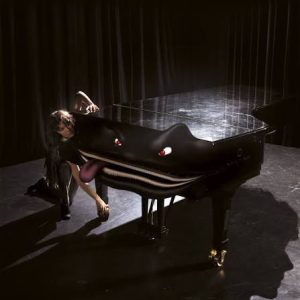 I occasionally like a Michael Lavorgna new music rec. Mostly I hate them, but the album covers are cool. I like Clarissa Connelly’s ‘World of Work‘ —both the music and the album cover, very Much. And the HFSA-02, also a recent Lavorgna fave, loves it. Big (expansive, really!), slightly warm and dynamic. Yup; really lets you hear the Aurora at its finest. Matter of fact, that about sums up the sound of this integrated. (Maybe that’s why this Lavorgna music rec sounds so good over this amp; they are made for each other!)
Head-to-head again with the Shindo using Beethoven’s string trios (and isn’t this how Beethoven really wanted his string trios to be used?) as played by the Busch Quartet on the superb Alpha Classics label, the F2a is lit up and sunny. The Aurora is immediately slightly more brooding; slightly darker, even utilizing silver Audio Note Vx interconnects and relatively ‘linear’ vintage Cifte 12au7s.
It is moving and beautiful tonally as well. I would liken the comparison to when I heard the Leben 600x here back-to-back against the EL-84-filled 300XS. The smaller 300XS was sunnier and lighter on its feet, and the 600 had more mid-bass heft; more gravitas. I’d say here the Shindo F2a plays the role of the 300XS and the Aurora, fittingly, is more 600X.
Through the Shindo Monbrison/F2a, a little more clarity. Through the Aurora, a little more gravitas and warmth.
In other words, the Aurora is the quintessential EL34 amp and the Shindo is… an F2a amp, which is to say it’s its own thing, as I don’t know of any other F2a amps offhand… Come to think of it, I believe Thoress makes one, but I unfortunately haven’t heard it.
In any case, the Aurora is the wetter, more redolent acoustic, and the Shindo is the sharper saber.
But wait—there’s more!
Comparison is the thief of joy, but NOT in a hifi review, where it is the very source of it! What about the redoubtable Lejonklou Boazu 2.0? Swedish solid-state vs. Japanese tubes?
Well, I’ll tell ya; broadly speaking, this went down about exactly along the lines of how tubes v. solid-state often does. The Boazu 2.0 did its even-handed, pacey-punchy, slightly warm thing, and the Aurora made its case that tubes provide a bit more contrast, density, and tonal beauty. They infuse a bit more ‘life’ into the sound at the expense of… expenses like repair costs, heat, and rare exotic tubes for which you pay many multiples of what they are worth because someone named Toobguy35 in a forum post from five years ago called them the greatest piece of glass that ever glowed.
 Turn the Boazu on in July, leave it on until you go away for Christmas this coming December. Play music or don’t. It doesn’t care. Almost as simple as my partner’s JBL Bluetooth speaker that seems to play Depeche Mode and ‘Pink Pony Club’ a lot. Maybe it’s broken.
Hey, speaking of broken- I recently had a 1950s tube do its level-best Chornobyl impersonation in one of my esteemed amps (not saying which one!), so I found out leaving them on while out and about is definitely NOT recommended behavior with tube amps. Fortunately, a 3-dollar fuse saved the world. I suppose it was doubly fortunate it wasn’t a 500-dollar SR Master fuse at that! Art Dudley watching over us, I can only suppose…
In the innuendo…
The Aurora held its own against all (much pricier) performers in my condo and then some. (Though certainly my partner’s JBL Bluetooth speaker gave it a run for convenience and portability).
The HFSA-02 is so good, I’m not sure you need to spend lots of money on more exotic wares. In terms of tonality and resolution, it is very close to, or nipping at the heels of, the best like-minded tube designs I could muster to put up against it.
It responded very well to ‘tuning’ to taste with various interconnect and power cord tweaks, and I’m sure would also respond quite well to whatever impossible-to-obtain exotic tubes you’d like to throw (carefully) at it (I only tried my Cifte 12Au7s so far).
In sum and substance, the Aurorasound HFSA-02 is a tour de force of an integrated amplifier. I found myself in fact listening to the Aurora many nights in preference to all of the other exotica I had on hand here.
I’m not sure how Aurorasound does it at their chosen price point, but they’ve done it again here. The HFSA-02 is beautifully styled, built with quality parts, and sings, dances, and performs for you accordingly, all while straddling the tightrope between warmth and linearity. Yep; ‘linear tone’.
If you own speakers of an appropriate sort, at its price, the HFSA-02 is, in my long experience, both emotionally and aesthetically very, very difficult to surpass.
As highly recommended as the medium-rare Ribeye at Peter Luger’s or essentially any 2019 Bordeaux.


I bid you peace.
Specifications:
Line integrated: 9,990.00
w/ phono option: 10,390.00
Specifications:
Input: RCA LINE x4
Option 1: Phono (MM) x1, RCA line x3
Option 2: XLR line (balanced) x1, RCA line x3
Volume control: remote control
Gain / Input sensitivity: 31dB / 440mV
Input impedance: 25kΩ
Output: 31W +31W @8ohm
Frequency Response: 10Hz–30kHz, -3dB
THD+N: 0.1% 1kHz
SNR: 98dB, A-weighted
AC power voltage: Europe/Asia model 240V/230V, USA 120V
Power consumption: 200W
Dimensions (W x D x H): 440 x 290 x 228mm without knobs/terminals
Weight: 20kg
Contact:
highend-electronics, Inc.
Alfred Kainz
19593 Roanoke Road
Apple Valley, CA 92307
Phone: 760-490-2410
Fax: 760-242-1065
Website: www.highend-electronics.com
Email: office@highend-electronics.com
Associated Equipment:
David’s associated equipment
Source
Grimm Audio MU2 streamer/DAC
Amplification:
Air Tight ATM-1S, Air Tight ATM-300R, Air Tight ATC- 6 line preamplifier, Shindo Cortese F2a, Shindo Monbrison preamplifier, Boazu 2.0 integrated amplifier
Loudspeakers:
DeVore Fidelity O/96, Stenheim Alumine 3, Fleetwood Sound Helios
Accessories:
Auditorium A23 speaker cables, Shindo silver interconnects, Audio Note Vx interconnects, Luna Mauve speaker cables, Linn K200 speaker cables, Grimm TPR interconnects, Shindo interconnects, Box Furniture modular rack, Torus RM 15 power conditioner.
Stereo Times Masthead
Publisher/Founder
Clement Perry
Editor
Dave Thomas
Senior Editors
Frank Alles, Mike Girardi, Russell Lichter, Terry London, Moreno Mitchell, Paul Szabady, Bill Wells, Mike Wright, and Stephen Yan,
Current Contributors
David Abramson, Tim Barrall, Dave Allison, Ron Cook, Lewis Dardick, John Hoffman, Dan Secula, Don Shaulis, Greg Simmons, Eric Teh, Greg Voth, Richard Willie, Ed Van Winkle, Rob Dockery, Richard Doron, and Daveed Turek
Site Management Clement Perry
Ad Designer: Martin Perry
Be the first to comment on: The Aurorasound HFSA-02 integrated amplifier by David Abramson