

Silversmith Audio Fidelium Speaker Cable by Mike Wright
 I was getting caught up with my good friend Daniel Barnum, ex-owner of the distribution company Half Note Audio when he shared some exciting news with me. He told me that our cable buddy, Jeffrey Smith of Silversmith Audio (herein Mr. Smith), wanted to talk to me about something new that he had been designing. When I asked him what it was, he said Mr. Smith had come up with a speaker cable that outperformed Silversmith’s top-of-the-line Palladium and is a fraction of the cost. All the while, I am saying to myself, “Yeah right.”
When I first got into reviewing, Silversmith Audio was one of the very first high-end cable manufacturers that came into my realm of consciousness, and the Palladium was something of a legend. I’d always heard of it but had never experienced it. A former ST writer let me check out his Palladium cables for a few weeks and was stunned by just how good they sounded. When I found out how much they cost, I was shocked again. I knew there was no way I’d be buying any of this stuff. It’s just way too expensive for my modest funds. Even when I met Smith, I felt the same way. Don’t get me wrong. Mr. Smith is a great guy. He’s a Navy man, engineer, and astute businessman. He’s also a fabulous audio designer and even built some of his audio gear for his system, which I’m told sounds exceptional. And when you talk to him about audio, he is even more impressive and knowledgeable. Mr. Smith knows his stuff and to a very high degree.
When Daniel Barnum told me that Mr. Smith wanted to talk to me about a new speaker cable, I didn’t think much of it. I was determined not to fall into some audio hype. The Silversmith Audio offerings were usually so expensive; no matter what “a fraction of the cost” was, it was still going too expensive for me. Thank God for Mr. Smith’s persistence. A few weeks later, he called me. After exchanging pleasantries and getting caught up, we started to talk shop, and he bought up the subject of his new Fidelium speaker cables.
Mr. Smith shared with me the same things that Daniel Barnum shared a month earlier but in more detail. I told Mr. Smith that I understood what he was saying but that I just figured he was exaggerating. I reminded him not only had I spent time with the Palladiums that from years ago, but that he had also sent Silver and Palladium speaker cables to listen to way back when. All Mr. Smith would say was, “Trust me, you won’t be disappointed.”

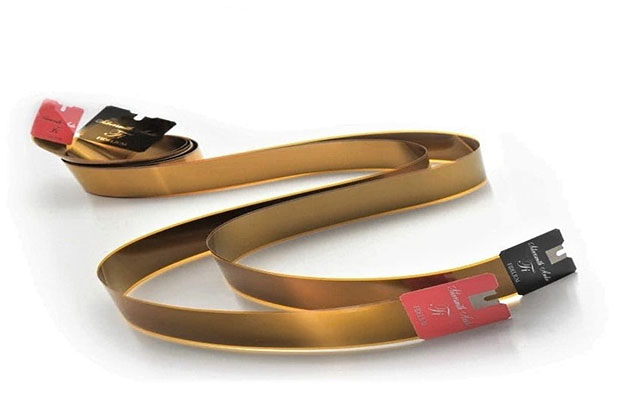
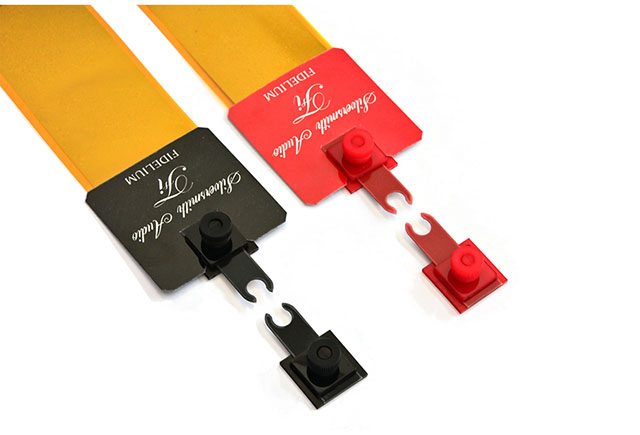
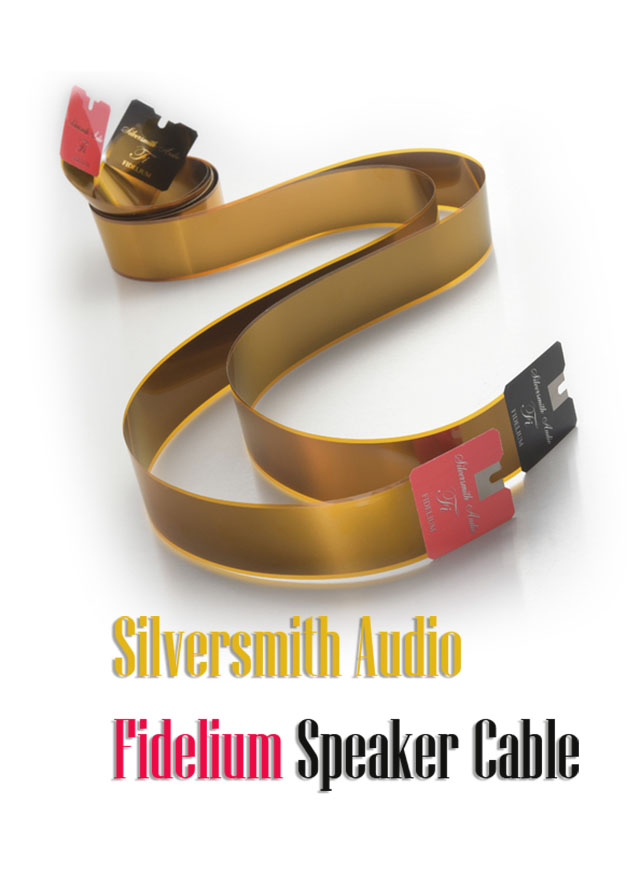
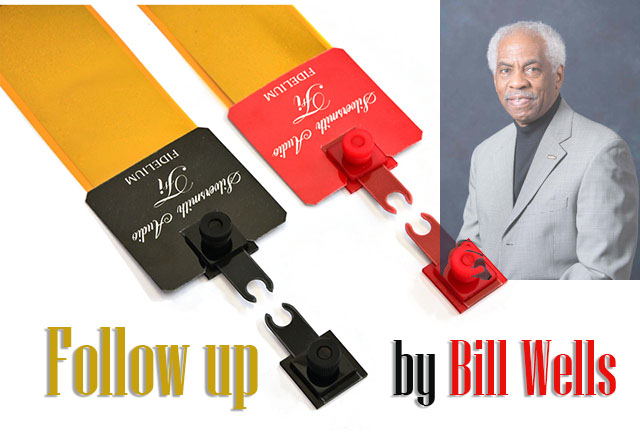
 A short time later, the Fidelium showed up at my home. Even this was a little surprising because they arrived in a box. Not just any package, mind you, but a box that you could fit a Seiko watch inside. Maybe a little taller. Once I opened this lightweight box, the Fidelium speaker cables were wrapped in a nice circle inside a watch-sized box. Now I am thinking, “What the heck?” Maybe Mr. Smith had hit upon hard times. What is this supposed to be? If you have ever used a flat ribbon cable, Mr. Smith’s speaker cables are flat, extremely light, but at the same time quite tough. Even though they do not have a lot of heft, you can tighten connectors on them tight. The Fidelium speaker cables are about 2.25 inches wide and less than 1/1000th of an inch thick. The cable sits inside of a very thin “polyimide laminate” outer covering. There are notches on each end of the cable designed like spade connectors, and there is a single run for negative and positive sides of your speaker cable and amplifier terminals. I had the Fidelium for about five days but was hesitant to insert them into my system because I did not want to “man-handle” them to get the notches to fit on the speaker and amplifier terminals. The Silversmith Audio Silver and Palladium speaker cables had these “not very wide” ribbons seated inside an attractive gold mesh jacket, whereas the Fidelium does not have a jacket. Humorously, Mr. Smith encouraged me not to be shy about taking hold of the Fidelium and folding or bending it in whichever position I needed to get it on my connectors securely. Just take care that the foil areas do not touch, same as you would to make sure your positive and negative speaker connectors do not touch. With that encouragement in mind, I had no difficulty putting the notched ends of the cables and torque them down on the speaker and amplifier connectors.
How It Sounds
 After finally getting the Fidelium hooked up in my system, I started listening with some encouragement from Mr. Smith. Right from the start, what was most apparent was how fast the Fidelium cable sounded. There was so much more detail, openness, and musical information that it was almost an assault on the senses, but in a very audibly pleasing way. The Fidelium produced tonal colors that were vibrant and energetic. With the Fidelium, instrumentals and vocals were delivered with a considerable amount of presence, realism, and believability. Upper frequencies were provided with an increased amount of airiness and clarity. Percussion kits possessed newly discovered bits of information, and sounds, previously hard to identify, were now easier to follow. There are still items on percussion kits that I have no idea of what they are called, but with the Fidelium I can easily tell what they sound like. Also, brass instruments sounded clearer and pierced the air just as they do at live venues. With the increases in clarity and transient detail came the ability to make following individual lines from singers and instrumentalists easier to follow if you like to pinpoint what a particular performer is doing. But all the speed, detail, and musical discovery came at a cost. Initially, the Fidelium’s bass performance, while not bad, was not quite what I was used to or even expecting initially. Still, the Fidelium was so revealing of the music that I was willing to sacrifice some bass performance for what I was getting in the midrange and the highs.
Eventually, my persistence began to pay off. After 3-5 more days, the Fidelium started to loosen its grip on the bass and rewarded me by extending the attributes it displayed with the midrange and highs down to the deepest bass. By the end of one month, I did not feel like I was being cheated out of any bass. With the Fidelium, the bass is detailed, full sounding, extended but still tight. Do not get me wrong. If your system lacks bass, the Fidelium will not change your speakers into bass mavens. Still, at the same time, if your system has bloated bass, and that being an artifact of your speaker cables, the Fidelium can tighten that up and cause it to sound more natural. On the other end of the spectrum, the Fidelium allows instruments like bells, triangles, and xylophones to sound so vibrant and have such natural decay that their notes linger in your listening environment.
 From the beautiful Kenny Werner Trio recording, “Live at Visiones” [Concord Jazz], you get to enjoy a live jazz recording, complete with the venue ambiance, people talking, and, judging by their applause, seemingly having a good time. On this performance, pianist Kenny Warner, bassist Ratzo B. Harris, and drummer Tom Rainey give us some beautiful music, such as on tracks like Wayne Shorter’s Fall, and the Miles Davis standard Blue In Green, and Mal Waldron’s Soul Eyes. All recorded with the mics up close. Mr. Harris’ bass, in particular, stands out on the track, Fall, and you get to hear what a live bass, microphoned up close, would sound like in your room. The Fidelium was adept at letting you hear the bass chords energetically, filling the room, and extending down to the low notes. It also did an excellent job of detail retrieval with the room sounds.
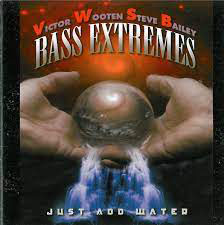 The Victor Wooten and Steve Bailey collaboration as the group Bass Extremes and their album “Just Add Water” [Shrapnel Records] is a conglomeration of the jazz, rock, and funk musical genres, generally a fun listening session. There is something for everyone on this recording, including such tracks as Mocha Soca, What Jamaican?, and Tropical Storm, but the track I kept coming back to was Music Of The Spheres. This track features Mr. Bailey playing the double bass and Mr. Wooten playing the cello. Those two instruments combined with some slightly eerie bell tones make for an interesting mix. The Fidelium did an excellent job of letting you hear the string detail of the bass and cello and the upper-frequency impact and decay of the bells (at least I think they are bells).
 The Fidelium does a great job with female vocals as well. A friend shared with me his appreciation for the Jacintha recording “Fire & Rain” [GROOVE NOTE]. Jacintha has such a lovely voice that I could listen to her for hours. From this work, I have been digging on Sweet Baby James. This track was recorded so beautifully. From the tonality of Jacintha’s voice to the stringed accompaniment that subtly comes in halfway through, the Fidelium does a good job of capturing all the subtleties of this track. Kicking up the energy a little bit was Joe Bonamassa’s, “Live From The Royal Albert Hall” [Premier Artists]. This recording was so much fun to listen to, one because it’s live, but also because of Mr. Bonamassa, whom until now, I had not listened to much of, is truly a virtuoso. Think of Stevie Ray Vaughn and B.B. King with some Clapton thrown in there, and that, in my opinion, is what I think of when listening to Mr. Bonamassa play. I found myself hooked on the dynamic drumming and Mr. Bonamassa’s guitar work on High Water Everywhere. The Fidelium has no problem allowing you to feel the energy and impact of the drums, and the sound of Mr. Bonamassa’s guitar pierces the air. The sound reverberates, making this recording that much more enjoyable. For all of you videophiles, I’ve heard that the DVD is even more enjoyable as you can watch as well as hear this fascinating concert.
A Few More Thoughts
The Fidelium is a great-sounding speaker cable that requires the patience of break-in. It does not give up hints into just how deep or powerful its bass performance will be but give it a few weeks, and I am almost sure you will be rewarded for your patience with it. What is unquestionable is the amount of detail retrieval, transient performance, and high-frequency extension the Fidelium can bring to your system. You do have to get used to using a cable like the Fidelium. As I said before, I just could not get used to being so handsy with it at first. I was so concerned with ripping and tearing it that I did not feel comfortable using it for the first week that I had it. It was not until Mr. Smith told me not to handle it like a piece of porcelain and not be afraid to turn, twist or manipulate it to get a good firm fit on my amp or speaker connectors. Once I got over that fear, making connections became quite easy. Mr. Smith has also developed a very nice set of jumpers that not only look good but sound good. I did not find that lifting the cables off the carpet using cable risers made that much of a difference, but I am sure some tweekers might find that to be helpful. Nor did I find letting one cable rest upon the other did anything to affect the performance.
For comparisons, I did not have a lot on hand to compare it to but did have some nice cables all the same. My Clarity Cable Organic is a very nice-sounding musical cable that I have had for a while. The Fidelium was just faster, more detailed, vibrant, and lively sounding. My even more expensive Klee Acoustics speaker cable did not fare as well I had hoped in its comparison to the Fidelium, and neither did my Sound Design Labs speaker cables. It’s almost as though Mr. Smith borrowed the DeLorean from “Back to The Future,” and came back to 2021 with a new cable that started running rings around all these cables I had on hand.
Conclusion
 The Fidelium is an exceptional speaker cable. At its relatively sane $995 price-point for a 6-foot pair ($795 for a 4-foot pair and $1395 for a 10-foot pair), the amount of performance it brings is a wonderful testament to Mr. Jeff Smith and Silversmith Audio. To go from the exorbitantly expensive Silversmith Audio Palladium to the much more realistically priced Fidelium and still offer you more performance for a fraction of the cost is quite an accomplishment. I know many us audiophiles lament the prices of some of these offerings, and rightfully so. But Silversmith Audio is doing its part in trying to “keep it real.” Kudos to Mr. Smith and Silversmith Audio for producing the Fidelium speaker cables. They are an outstanding accomplishment and deserving of the “Most Wanted Component” award they received for 2020. Highly recommended.

mike wright
Personal Reflections
Quite frankly, there’s nothing like reconnecting with someone from your distant past, especially when it’s coming from a very positive place. In fact, trying to recall exactly when the last time we were in touch was has been challenging for both of us to remember. At this point, all I remember is an introduction that took place during CES in Las Vegas circa the early-to-mid 2000 timeframe. The occasion took place as I was visiting with Sean McCaughan, designer/manufacturer for the former and highly regarded ESP Concert Grand loudspeakers. Those were my reference speakers at that time, so I was most interested to check out the ESP exhibit and see if there was anything special happening, sound-wise.
As often happens during high-end audio shows, whether due to room conditions, power issues, or whatever, an exhibitor may not have such good fortune in getting really good sound right from the very beginning of the show. I distinctly recall that it was the second day of the show (i.e., Saturday), and the sound in this exhibit wasn’t quite where it should be. Again, having these speakers as my reference at the time helped me to be very familiar with their sound, so at this show, I had high hopes for hearing something familiar and even beyond. Frustration was definitely on the face of the exhibitor, and the issue seemed to have something to do with not having the correct speaker cables. The sound was good but not quite at the level hoped.
Back Story
 Enter Jeffrey Smith with a cache of his unique silver and palladium speaker cables. Appearing somewhat fragile and definitely unusual from anything I had seen in the way of speaker cables, I was most curious as to how this was going to play out. With a fairly quick replacement of the demo cables with the Palladium speaker cables, it was truly one of those “Holy Crap/You Gotta Be Kidding Me” type moments. In terms of the level of improvement with these cables in place, the system’s sound literally came to life, illuminated with sensational musicality. And the transformation actually covered the entire frequency spectrum with significant improvements in the bass, midrange, and upper frequencies. In fact, there was no apparent weakness that I could detect.
This was definitely a big boost for ESP, although it was a bit late for the show, and unfortunately, not nearly as many attendees were able to experience the wonderful sound for themselves as had been hoped.
For me, the story doesn’t end there. The good news is that I was fortunate in that later, I was able to secure a pair of both the Silver and Palladium speaker cables to audition in my home reference system. However, the bad news was this – even though I was able to secure a connection of the cables to my speakers/amps, due to some damage (i.e., shipping, other) – I wasn’t able to secure a proper enough connection and ultimately had to return the cables for repair. As things turned out, Jeffrey was actually in the process of modifying/updating these cables, and unfortunately, I wasn’t able to secure another pair for additional auditioning.
That Was Then and This Is Now
 Fast forward from those earlier days, and more recently, I was able to reconnect with Jeffrey and specifically to learn directly from him about his latest (and greatest) incarnation of hi
One thought on "Silversmith Audio Fidelium Speaker Cable by Mike Wright"
Leave a Reply



Stereo Times Masthead
Publisher/Founder
Clement Perry
Editor
Dave Thomas
Senior Editors
Frank Alles, Mike Girardi, Russell Lichter, Terry London, Moreno Mitchell, Paul Szabady, Bill Wells, Mike Wright, and Stephen Yan,
Current Contributors
David Abramson, Tim Barrall, Dave Allison, Ron Cook, Lewis Dardick, John Hoffman, Dan Secula, Don Shaulis, Greg Simmons, Eric Teh, Greg Voth, Richard Willie, Ed Van Winkle, Rob Dockery, Richard Doron, and Daveed Turek
Site Management Clement Perry
Ad Designer: Martin Perry
Well Brother Mike, you have capture my full attention with the buffet you put before us from your unbiased review of the Silversmith Fidelium speaker cables, created by Brother Jeffrey Smith. Your review gave a clear insight into Brother Jeffrey personal thoughts for engineering/ creating these speaker cables, but more importantly your personal test by using your own audio equipment and a variety of music genre’s is what delighted my palate. I love the way you took the time to explain in details each entree. I couldn’t get enough, my appetite was increasing with every test you put Brother Jeffrey, Fidelium through. If the appetizers was introducing Brother Jeffrey Smith to us and the entree’s was the real testing of the cables and your honest opinion of the High quality of these 5 star cables, I’m ready to place my order with Executive Chef Jeffrey Smith for desert. As a retirement gift to myself ( 43 years of service/Buffalo Police Officer ), I decided to create what I title a Audio Quilt, a variety of pieces, once mended together, will bring many seasons of comfort, joy, and pleasure. This endeavor is being supervised by George W.Weathington (Lucci), president of Highend Fanatics on facebook. His recommendation and this review by Brother Mike Wright, I will be placing my order to acquire another piece to the quilt. Thank you, Mike.