
Classé Audio Delta PRE and MONOs amplifiers By Dave Thomas
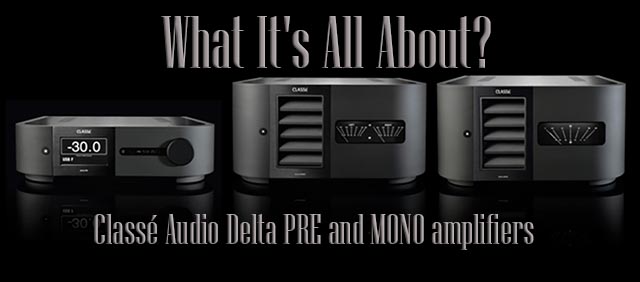
 Classé Audio has always been a fascinating company to me. Even going back to one of my early favorite amps, the legendary DR3 VHC Class-A amplifier, I’ve always looked at Classé as sort of a renegade among the high-end audio elite. Back in the late ’80s and early ’90s, the landscape of high-end audio equipment was dominated by companies like Krell, Conrad Johnson, Audio Research, and Jeff Rowland Design Group. When Classé came on the scene, not only were they producing gear that was at least of equal quality and craftsmanship, but they were just as sonically spectacular and seemed to be more reasonably priced. Today, while Classé and those other companies are still in existence, the high-end audio landscape has changed tremendously. This review will look at the latest offerings from Classé: The Delta PRE preamplifier and Delta MONO monoblock amplifiers. By the end of this review, I hope to give you (and myself) a better understanding of where this venerable company stands in the high-end audio Pantheon.
About My First Touch of Classé
 My first review of a Classé component came in 2005 when I reviewed the first generation of Delta products; the CP500 preamp and CA2200 power amp. I remember having been with Stereo Times for about a year or so and struggling mightily to get review samples. I also remember going to my first CES in Las Vegas since joining Stereo Times and stopping by the Jeff Rowland Design Group room. I was a HUGE Rowland fan and always enjoyed listening to their setup. After listening to a few tracks, I caught Mr. Rowland alone and thought it was a good time to take a shot at asking for a review sample of the Concentra Integrated amp. He politely, though decisively, declined, stating they were not sending review samples to internet publications. Bubble busted. And since there were no Rowland dealers in the Chicago area at the time, the brand became out of sight and out of mind to me.
Luckily, just a few months after that same CES, I got a call from Stereo Times publisher Clement Perry, who told me that he was very fond of Classé Audio products and that I may want to get in touch with their VP Dave Nauber. Within days, I reached out to Nauber and found two things: first, he was accessible. There are a lot of high-end audio companies whose leadership appears to be more mythology than a real person; I mean, you simply just can’t reach them, whether via email or phone call or drone or PI… you know what I’m saying. The second thing was that he was incredibly accommodating. Despite the fact that the only thing he knew about me was that I knew CP, he still gave me my pick of equipment to review. When you’re relatively new to the game, as I was then, that was a tremendous gesture. But Nauber’s consideration of my request was not an anomaly. When the next year’s CES came around, he invited me to stop by the suite he had at the Mirage, right across the street from the Venetian, where he was entertaining guests and other industry folks and discussing a static display of some new products from Classé. He was just as warm and friendly as he had been in our phone discussions. On top of that, he was just as accommodating. One of those new products that Classé was rolling out that year was a new CD player called the CDP-102. In a matter of weeks, a review sample arrived at my house.
During the past decade, the fortunes of Classé have endured a few moments of uncertainty, but that all changed in 2018 when Sound United acquired the brand. Sound United appears to have brought stability to Classé, particularly by leaving Dave Nauber in place as the brand’s Director. Nauber is simply one of the most cerebral, knowledgeable, and down-to-earth people I’ve met in high-end audio… or in life, for that matter. I’m grateful that he continues to represent such a fabulous company and products. And speaking of those products…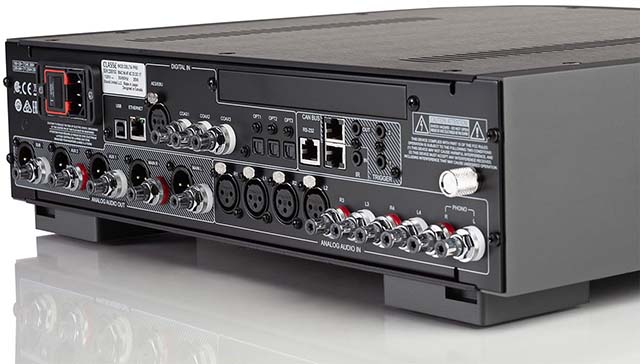

About the Classé Delta PRE
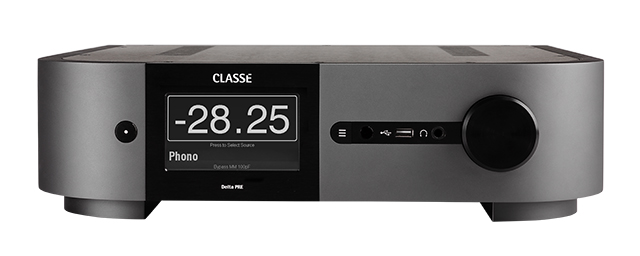
The Delta PRE is designed to be a holistic solution to integrating all of your audio/video sources into one superbly designed and engineered control unit. The first thing you notice as a noticeable departure from earlier versions of the Delta Series is that even though the gently rounded corners are still present, the soft silver chassis has been replaced by a dramatic looking basic black aesthetic. These components have a bespoke look and feel to them, like James Bond in a basic black tuxedo. Elegant, serious, and capable of almost anything.
The front of the Delta PRE is deceptively understated when you consider just how much flexibility it gives you and the broad array of source components it allows you to control. You’ll find a standby button, a menu button, an infra-red sensor, a 6.35mm headphone jack (which I’ll spend more time on later), and a USB input (thoughtfully referred to in the manual as USB-F for “Front”) that was specifically designed with iOS devices in mind. Also held over from the previous Delta designs are an LCD touchscreen and a hockey puck-sized rotary knob for adjusting volume and navigating the screen. This analog-domain stepped attenuator features enough steps to allow the user to make volume adjustments in the tiniest of increments and uniquely tailor the output of each source component. As if this wasn’t a wonderful enough level of thoughtful design, consider that Classé also offers an app that puts all of this functionality into your smart devices.
The rear panel of the Delta PRE is where you start to appreciate the vast array of sources that it will accommodate. Right away, I noticed that there was a phono section that accommodates both moving coil and moving magnet cartridges. So I knew right away that I would be comparing it to my Pass Labs XP15 phonostage. The same for the DAC section, which will be compared to my Vitus Audio RD-100 DAC/Linestage. More on those comparisons later.
 Looking at the top row of connections (from left to right), you’ll find a solid rocker switch that powers the unit on and off. Next to it is the IEC power cord receptacle. Let me mention here that the Delta MONO amps come supplied with power cords specifically designed for them by DR Acoustics. They are a significant step up from the cords that were provided in the past. Next to the IEC receptacle is a bank of “DIGITAL IN” connections. Simply put, the Delta PRE offers an embarrassment of riches when it comes to inputs: nine (9) digital (USB, Ethernet, AES/EBU, three COAX, and three OPTICAL) and five (5) analog inputs (two XLR, three RCA), and as I mentioned above, one of the RCA inputs is a dedicated phono input. Next to the digital inputs are the network and home automation system connections to allow you to easily integrate the Delta PRE into your home theater network and even update its software.
Along the bottom of the rear panel are the ANALOG AUDIO IN and ANALOG AUDIO OUT connections. On the left are a bank of XLR and RCA connections for SUB, AUX1, AUX2, and the MAIN outputs. Next to that are two sets of XLR inputs and three sets of RCA inputs, including the PHONO inputs. Also, just above the phono inputs is a ground (GND) connection.
The USB input is PCM 32-bit/384kHz and DSD up to 256kHz. The AES/EBU is PCM up to 32/192kHz, and the coax and optical inputs are PCM up to 32/192kHz. The Delta PRE’s built-in DAC uses AKM 4497 32-bit DAC chips implemented in dual differential mode. The Ethernet connection is great for networked devices. It allowed me to sideline yet another piece of equipment from my reference system, the Bricasti M5 Network player. Computer system-based audiophiles will love being able to run a high-quality Ethernet cable straight into the PRE and avoid the drawbacks of WiFi. Though admittedly, the improving quality of high-speed modems is minimizing the impact of buffering.
Setting up the phono input via the LED menu allows you to automatically bypass DSP modules and lets you choose from either low-output moving coil, high-output moving coil, or moving magnet cartridge settings. Impedance loading for moving magnets can then be set at 50-450pF, low-output moving coils at 7.5 Ohms to 1k Ohms or 47k Ohms for high-output mc cartridges.
Another nice feature of the Delta PRE is the “balance” and “tone controls,” which can allow precise digital audio filtering to balance out some of the sonic anomalies created by your speakers, components, or room configuration. Don’t get me wrong; I know that most audio purists cringe at the notion of tone controls, but bear in mind that with the proliferation of source components that the Delta PRE can accommodate (including TVs, gaming consoles, smart devices, etc.), the ability to tame some of the amusical attributes that these components can impart, grow in importance. If nothing else, it’s just nice to know they’re there.
Before I move on to the MONOs, let me revisit something that is far too often overlooked on high-end preamps; the headphone amp. This 6.5mm jack is part of a high-quality headphone amplifier with an X-Feed (Crossfeed). This technology adjusts the phase to create a more realistic, wider soundstage while doing away with any unnatural sounding audio gimmickry.
I had just received the excellent Audeze LCD-X headphones for review and just in time to evaluate them with the Delta PRE. Let me tell you; this was an experience. I won’t go into a lot of detail about this combination here, but I will tell you about the performance of this headphone amp when I played one of my all-time favorite live concert DVDs through it. Pink Floyd’s Pulse concert film features a fantastic performance by David Gilmour on the song “Comfortably Numb.” It simply must be heard to be believed. As played through the Classé CDT 300/Delta PRE/Audeze setup, the sound was HUGE and dynamic, yet draws the listener in so deeply that it is one of the most emotional experiences you will have listening to rock music. I’ll discuss this headphone amp more in my upcoming Audeze LCD-X.

_1.jpg?KeepThis=true&TB_iframe=true&height=430&width=700)

About the Classé Delta MONOs
Here is where everything changed. After wrestling these behemoths into position in my listening room, and believe me, with the nearly 100-pound MONOs not having any handles, this was no small feat. But once connected to my Tekton Double Impact SE loudspeakers, getting the system up and running was a breeze. It was late when I turned them on and ran the cable channel Music Choice: R&B through them, keeping the volume at a late-night comfortable -45.00 dB. Now typically, that volume level will get you some low-end from your music, but not much. But when “All Day Music” from the soul supergroup War came on, I was shocked at just how much low-end energy and music I was getting. It was then that I remembered that the first 35 or so watts of the MONOs were pure class-A. Suddenly I was reminded of the venerable DR3 and some of the other genuinely great class-A amps from the past and what made them so memorable. But let me get back to describing these beauties before getting into the music.
At around 18″ wide x 19″ deep x 9″ tall, the Delta MONOs are no joke. And the basic black form that looks so good on the Delta PRE is twice as impressive on the MONOs. But there is even more to the design of the MONOs that is a departure from previous Delta designs. First, you can’t help but be drawn to the beautifully backlit output meters displayed on the right side of the front panels. The output power is shown as watts into an 8-Ohm load. As a point of reference, the first-meter mark to the right of center is 30 watts. When the pointer is left of that mark, the amplifier is operating in class-A. The backlight of the meter can be adjusted to one of three levels of brightness or can even be turned off. Outside of those initial 35 watts of class-A, the MONOs are rated at 300 watts class-A/B into 8 Ohms, 600 watts into 4 Ohms, and 100 watts into 2 Ohms, and as Dave Nauber himself told me, “it does so with tons of power.” The other significant change is the Intelligent Cooling Tunnel (ICTunnel Air Intake) system which removes heat from the amplifier circuitry by using a fan to pull cool air through the intake on the front panel of the amps. The cooling system helps the amp to maintain proper operating conditions and allows you to place it in cabinets or racks where conventional amps can’t go without, wait for it… fans!
Let me clarify something about the use of fans. In lesser designs, there have been issues with fan noise in amps. The fan that Classé uses works at a relatively slow speed so as not to create any noise. The only other thing on the front panel is a standby button which sits just to the left of the ICTunnel. Oh, by the way, the front panel vent for the ICTunnel is removable for cleaning. Sort of like the lint catcher on your dryer. Nice touch.
In the upper right corner of the rear panel of the MONOs is where you’ll find one RCA and one XLR INPUT connector. To the left of that is the ICTunnel exhaust port. This is where warmth from the amplifier is pulled through and out of the unit, though you hardly feel anything blowing out of that port. To the left of the exhaust port are a pair of high-quality Furutech Torque Guard five-way speaker binding posts. All RCA connectors for both Delta components are rhodium-plated copper and also designed by Furutech. The XLR connectors are by Neutrik. Above and left of the speaker posts is the IEC power cord receptacle.
On the left side of the amps are your network, home integration, and control connections (IR input and output, DC Trigger input and output, RS232 control port, RJ-45 – DB9 female adapter). There is also a USB port and Ethernet port. The USB port allows you to use a USB stick to update amplifier firmware, and the Ethernet port allows you to connect to a local network to update features via an IP address.
Inside the amp, you will find a massive, vertically mounted, 2.35kVA toroidal transformer. This transformer is made of 540 meters of copper and weighs nearly 37 pounds. Mounting the transformer vertically helps prevent any electromagnetic noise from impacting the audio circuitry. Also inside is the ICTunnel, a nicely made soft silver-colored aluminum tunnel that runs the length of the chassis. The MONOs also use 32 output transistors and 22 Mundorf 4-pole storage capacitors, which discharge and refill current extremely quickly. Finally, one more nice touch I wanted to mention was the use of specially designed damped feet from Navcom that are used on both the MONOs and the PRE. There are thoughtful design touches and the highest-quality parts used throughout these components, which is reflected in their high, but not high (IMHO), costs.
So now it’s time to put these components together, fire up some music and see what all of this great stuff means in terms of music (I miss that magazine).
About the Music
The Delta PRE and MONOs arrived not long after adding the fabulous Tekton Double Impact SE loudspeakers to my reference system. They are replacing my long-loved Maggie MG20s. The Maggies aren’t going anywhere, mind you, but I needed to add a pair of speakers that do not require four channels of amplification the way the Maggies do. I also had to use an electronic crossover, which was the Pass Labs XVR-1. So, where once I was using the Maggies with the XVR-1, a pair of Bel Canto Ref1000M mono amps (tweeter) and M300 mono amps (midrange/bass), I am now using the Tektons, the Delta PRE, and Delta MONOs. Another change was going from using the Vitus Audio RD-100 DAC linestage, Pass Labs XP-15 phonostage, and Bricasti M5 Network Streamer. You are starting to see the impact that the Delta gear is having on my system? By adding the three boxes, I’m taking out seven. And we haven’t even considered the impact on cabling and shelf space.
 So again, the question is, how have these changes impacted my system? I had been listening to my system for a couple of weeks, mainly as background music during the day while working from home like so many others during this pandemic. So when I finally settled in for a night of serious listening and note-taking, I knew the system would be fully broken in. I began my listening sessions by opening my Apple Music library on my MacBook Pro and playing Robert Glasper’s album, Canvas. Glasper has been one of my favorite jazz pianists over the past decade, and this album is a big reason why. His highly personalized performances were the perfect way for me to start getting into the Delta gear. The first track that I listened to was the title track, “Canvas.” Glasper and his bandmates Vicente Archer (bass) and Damion Reid (drums) play music that is intimate and really draws the listener in if rendered properly by your system. I got that and more.
The Delta gear portrayed this music in a way that was new to me, although I’ve heard it dozens of times before. The piano had amazing richness and allowed me to feel the sound of the hammers striking the piano strings, but also the texture of the vibrations on the strings. Another song from this same album, “Enoch’s Meditation,” provided the same result, except this time, there was also the depth of Reid’s drum work. This is where the MONOs showed their strengths. The sound of the kick drum was unforgettable. It was deep and very tight, and the percussive nature of the entire drum kit was true to life. I remembered hearing it years ago when they performed at Joe Segal’s Jazz Showcase here in Chicago. Great performances are unforgettable, and that’s what the Delta gear provided.
 Another song from my Apple Music library that would demand the best from the Classé Delta gear is “Easy Money” from the Lars Danielsson Trio. This live digital download is one of my favorite recordings. Danielsson is a brilliant bassist, but this song is particularly memorable for Leszek Mozder’s dynamic piano playing. I’ve seen and heard this performance on a couple of YouTube channels, so I know how the soundstage is usually setup. The Delta PRE nails it brilliantly. Remember, I’m running an Ethernet cable directly into the PRE and bypassing the Bricasti M5. The Ethernet connection is used to enable streaming of audio using Apple’s AirPlay or DLNA. The difference in going directly into the Ethernet port was noticeable. I experienced greater clarity around the instruments, and the sense of the venue was fantastic. I now feel a need to invest in a higher quality Ethernet cable to see how much more I can get from my downloads.
Now it was time to move on to some vinyl. The Pass Labs XP-15 has been my reference for years, and I suspected that it would be the one piece that could hold up well to the Classé Delta PRE. I had only recently added the Air Tight PC-7 low output moving coil cartridge to my analog rig and had reached a solid level of comfort with it. So the Delta PRE’s phono section, with all of its idiot-proof cartridge adjustments, was going to have to be special. Initially, it wasn’t. As I mentioned, the Pass had become very solidly entrenched in my system. So the Delta PRE’s phono section would have to play catch up. I spent an entire weekend working with the PRE’s menu and finally settled on selecting the “low-output moving coil” option and the loading at 100 Ohms. Strangely, the biggest improvement came when I switched out my Soundstring Gen II Platinum cable between the tonearm and phono input and added a 1m Entreq Apollo cable instead. The Apollo is an interesting blend of pure silver and copper wiring that tends to be a bit on the analytical side, which is what I like from my analog setup. That made it a perfect fit for connecting my turntable to the Delta PRE’s phono section. The result was analog bliss.
 The first piece of vinyl that I dug into was Stevie Wonder’s classic, Songs In the Key of Life [Tamla T13-34062]. Every song on this double album is fantastic, but none more than “I Wish.” If you’re familiar with this song, then you know that it is rich with dynamics that will test the limits of any system, starting with the bass chord at the start of the song, and there is simply nothing like the horn section that dominates the last minute of the song. The Delta PRE renders that opening chord, and it sounds like bass notes being played from instruments and not just low-end rumbling. The dynamics from this song are so intense that I found myself cranking up the volume and becoming addicted to the immense musicality that was filling my 26′ x 20′ x 8′ room. From this same album is another song that gave everything I loved from “I Wish,” and just a little bit more from the song, “Sir Duke.” That “more” was in the form of bass performance from the Tektons that I didn’t know they could deliver. I’ve listened to this song many times through my Maggie/Bel Canto setup, but it was wholly outclassed by what the Tekton/Classé setup could do. I remember writing in my notes, “Sorry, Maggies, I wasn’t ready for this.”
 The final recording of note is one of my favorite vinyl discs, the 45-RPM pressing of Patricia Barber’s Café Blue [Mobile Fidelity MFSL 3-45002]. This is an album whose songs should be familiar to most audiophiles, but the level of detail that was pulled from this version was amazing. From the start of the opening track, “What A Shame,” it is obvious that the Delta MONOs was something special. Driving the Tektons, the Delta PRE/MONOs combo rendered this song with loads of soundstage detail. The space occupied by Barber’s piano was prominent, as was the holographic quality of her smoky voice. Throughout this song, the wonderful bass line had natural depth and resonance and sounded like it was coming from an acoustic instrument and not a synthesizer as it sometimes can.
“Ode To Billy Joe” was another tune that contained a really cool bass line, but it also is accentuated with finger-snaps that popped through the Tektons. This was the coolest this song has ever sounded to me. Finally, I got into the best song on this great album, “Nardis.” It features piano and percussion solos that are a “must hear” for evaluating any audio component, which is probably why you hear it so much at the various high-end shows. Rhythm, pace, and speed all blossom through the Delta PRE/MONOs, drawing you deeper into the musicians’ performance. They all seem to be occupying realistic spaces within the soundstage, and you get a real sense of the room they must’ve been in, giving you that “live” recording feel. I’m not sure you could ask for much else from a home system.
About Those Comparisons
As previously mentioned, adding the Classé Delta PRE allowed me to remove several other components from my reference system. Bear in mind that the other components in my system were probably about ten or more years older than the Delta PRE and MONOs, so there is undoubtedly a significant probability that the Classé gear will sound better. As I’ve already mentioned in the case of the Bricasti M5, being able to go directly into the Ethernet connection on the PRE is certainly an advantage that led me to prefer it over the M5. But comparing the Pass XP-15 to the Delta PRE’s phono section was a different story. Considering that the Pass has been anchoring the analog setup in my system for years, my biggest hope for the Delta PRE’s phono section was for it to be at least comparable to the Pass. Initially, it wasn’t, at least not until I had more time to adjust its settings and try a couple of other cables. Eventually, I did get the results that I was hoping for, and the PRE’s phono section did give me a performance that was at least as good, and on some recordings, better than the Pass.
But the most important comparison was between the Classé Delta PRE and the Vitus Audio RD 100 DAC Linestage. Functionally, the PRE gives you far more flexibility with nine digital inputs than six for the Vitus. The PRE gives you the Ethernet input that is a huge plus because it eliminated the need for the M5. The PRE also gives you the dedicated phono section that again eliminated the XP-15. It also gives you three optical inputs compared to one for the Vitus. This was another plus as it allowed me to run my 65″ LG TV’s audio output directly into the PRE.
In a bit of a surprise, the Vitus sounded better when paired with the Delta MONOs than it did with the Bel Canto Ref1000M mono amps that it has been paired with for years. The Vitus linestage and the Delta MONOs were shockingly good together and drove the heck out of the Tektons. But when I finally installed the Delta PRE with the MONOs, the system was transformed. The sensation was similar to components with an XLR connection instead of an RCA. There was this sense that the components somehow “locked-in” with each other, and musically they achieved the synergy that I heard when I listened to the Patricia Barber album. Stunning.
About This Conclusion
The opportunity to spend time with the Classé Delta PRE and MONOs has been a special one for me. I’ve admired this company and its hardworking leader for a long time. But in these new Delta Series products, they have done something that is a bit rare in high-end audio these days. They’re giving us more of what we want from our systems while also dramatically improving the product and, most importantly, managing to keep the costs of the products within reason. Think I’m exaggerating? Take a look at Stereophile’s latest “Recommended Components” issue and see what other companies are asking for comparable products. You’ll be surprised.
But that’s beside the point. Regardless of what others may be doing, in my opinion, no other audio company offers this combination of operational flexibility, high-quality parts, thoughtful design, build quality, and faithfulness to the performance of music. Well done, Classé! Don’t bother sending a shipping label for these babies. They’re staying put. Unfortunately, that also means that I see a trip to Las Vegas in my wife’s future. Happy wife, happy life. That’s what it’s all about.


Dave’s Associated Equipment
Analog Front End
Small Audio Manufacture Aldebaran Turntable
Small Audio Manufacture Calista II Tonearm
Abis SA-1.2 tonearm
Air Tight PC-7 phono cartridge
Digital Front End
Classe CDT-300 Transport
Vitus Audio RD-100 DAC/Linestage
Bricasti M5 Network Player
Software
JRiver
Tidal
Apple Music
Amplification
Bel Canto Ref 1000 Mono Amps (tweeter/midrange on MG20)
Bel Canto M300 Mono Amps (bass on MG20)
Pass Labs XP-15 Phonostage
Pass Labs XVR-1 Electronic Crossover
Loudspeakers
Tekton Design Double Impact SE Loudspeakers
Magnepan MG20 Loudspeakers
Audeze LCD-X Headphones
Cabling
Soundstring GEN II Platinum cables
AudioQuest OptiLink optical cable
AudioQuest Forest coaxial digital cable
Entreq Apollo RCA cable (phono)
Accessories
Adona Corporation Zero GXT Equipment Stand
Acoustic Revive RTP-2 Ultimate Power Supply Box
Isoclean 60A3 II Power Conditioner
Entreq Vibbeaters
Entreq AC Wraps
Specifications:
Classé Delta PRE Preamplifier
Type: Two-channel solid-state preamplifier with DAC and phonostage
Analog inputs: Two balanced, three RCA (one designated as phono)
Digital inputs: Coaxial (3), optical (3), AES/EBU, USB, HDMI optional
Phono inputs: Two supported (one XLR, one RCA) configurable for moving magnet, low-output moving coil, and high-output moving coil
Formats supported: USB input: 32-bit/384kHz PCM and DSD2.2/5.6/11.3MHz, coaxial, optical, and AES/EBU inputs up to 32-bit/192kHz PCM
Outputs: Balanced and RCA right and left, subwoofer, two aux (one can be assigned to a second sub)
Dimensions: 17.5″ x 4.75″ x 17.5″
Weight: 29.8 lbs.
Price: $9,999.00
Classé Delta MONO Amplifier
Type: Solid-state Class AB stereo amplifier (Class A to 35W/8 0hms)
Output power: 300W into 8 0hms, 600W into 4 ohms
Inputs: One XLR, one RCA
Input impedance: 82k 0hms (balanced and RCA)
Outputs: Two pairs of 5-way binding posts
Dimensions: 17.50″ x 8.75″ x 19.4″
Weight: 97.7 lbs.
Price: $21,998.00/pair
Address:
CLASSÉ Audio (A Division of Sound United, LLC)
380, rue McArthur
Saint-Laurent, Québec
H4T 1X8
Canada