

Jones Audio PA-M300 Series 2 Mono Amps
|
Jones Audio PA-M300 Series 2 Mono Amps |
|
Less Noise, More Music! |
|
|
|
May, 2012 |

 One of the highlights of the 2012 Consumer Electronics Show was wandering into the Jones Audio room, where I was impressed by a system that featured their PRE S-1 preamp and PA-M300 Series 2 mono amps driving a pair of Revel Salon 2 loudspeakers. The system was fronted by both a Memory Player by Laufer Teknik Corp and an OPPO Digital BDP 95 Universal Disc player. The sound in this room was big and lifelike and immediately appealing. My first thought was that these electronics were from yet another overseas high-end company whose fanatical commitment to build quality and gorgeous aesthetics would make them unrealistically expensive and, therefore, unlikely to grace my listening room. But much to my surprise, it turns out that Jones Audio is actually an American company located near Seattle, Washington and that the components were priced at $12K and $24K for the preamp and mono amps, respectively. Yes, I know this is still a whole lot of money but have you seen the prices of what passes for high-end gear these days?!
All I knew was that I wanted to learn more about this company and their products, so I called and talked to Dan Meine at Jones Audio, and, much to my surprise, he seemed rather eager to have me do a review. No need for my stalker’s disguises or ski mask this time. Unfortunately, the preamp wasn’t available, but I was more than a little excited to bring in the PA-M300 Series 2 mono amps. Besides, I was fresh off of spending nearly a year with the comparably sized and powerful Classé Audio CA-M600 mono amps, so I had a great reference point for comparison.
About Jones Audio
Besides quickly responding to my review request, Dan Meine was kind enough to provide me with a lot of information on the company’s founder, the brilliant Sam Jones, the amplifier’s design and construction features:
Sam Jones created “GAUSS TM“, a mathematical and statistical programming language widely used for econometric analysis and modeling. Universities, consultancies, large financial institutions, central banks, and insurance and pharmaceutical companies worldwide rely on GAUSS for large-scale research, analysis, and modeling. The average GAUSS user has a PhD in economics, econometrics, statistics, math, or a related field.
After running his software business for nearly a quarter-century, Jones decided that he had reached a point in life where he could pursue his other passion: high-end audio. He transitioned into a consulting role with his software business, then started his first company, where he began researching and designing audio amplifiers full-time. For the next six years, Jones dedicated himself to creating the PA-M300 amplifiers.
Design and features
The Jones Audio power supply is designed to deliver the current and amplitude any modern loudspeaker needs to reproduce the full dynamic range of music. Jones amplifiers feature ultra-low-noise, 1kVA shielded toroidal transformers, which remain silent even under the most adverse line conditions. The cores of these transformers are wrapped in multiple layers of grain-oriented silicon steel to attenuate stray magnetic fields.
Because large power supplies can create much more noise than smaller supplies, Jones physically isolates their power supply from the delicate audio signal. Their use of shielded, low-noise toroidal transformers further minimizes power supply noise. Their audio circuitry is also laid out to allow for very short signal paths, which tend to reject external noise. Finally, they use unregulated power supplies that deliver a unique combination of low noise and high power.
The Jones Audio amplifier circuitry has a high Power Supply Rejection Ratio, which allows it to ignore power supply fluctuations. Because these circuits have a finite response time, adding a regulated power supply (common in many other large amplifiers) can hurt power-supply rejection and result in poorer high-frequency reproduction.
Jones uses Lateral-MOSFETs, the only output devices designed specifically for high-powered audio applications. Lateral-MOSFETs are much faster than similarly sized bipolar transistors. They are also much less sensitive to bias adjustments, which means they perform flawlessly under a variety of conditions — and for a very long time. Finally, they are immune to thermal runaway and secondary breakdown, which further increases their longevity.
Jones amps also use dual-differential, fully complementary input stages, which reduce the amount of common-mode noise that reaches the amplifier gain stage. This eliminates or greatly reduces noise and distortion caused by component differences, resulting in a quieter amplifier with lower levels of harsh odd-order harmonics.
Another advantage is increased slew rate and symmetrical slewing. Slew rate measures how fast the amplifier is, or how quickly it can process transients. A faster slew rate means the amplifier can respond more quickly to transients and has better high-frequency response. Because the slew rate is symmetrical (meaning the slew rate is the same for both rising and falling signal amplitude), the music stops as quickly as it starts.
Beauty of the beast
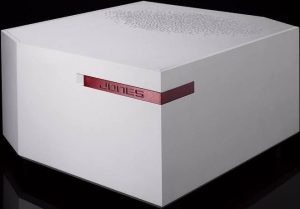
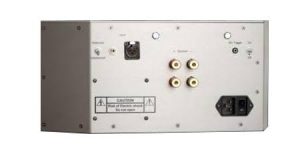
The physical presence of the Jones amp is breathtaking. The chassis is meticulously machined from solid slabs of aircraft-grade aluminum, held together by precise custom-made stainless steel brackets (which are themselves machined from solid plates of stainless steel). One corner of the front and rear chassis panels is elegantly chamfered for a unique and artistic look. The front panel also features a red anodized aluminum bar with the company logo engraved on it. At the end of this strip, a cobalt blue light illuminates a lovely soft blue glow when the amp is turned on. Speaking of which, the amp’s power button is neatly located underneath the front panel and helps keep the amp’s look clean. The amp’s rear panel is quite simple. It has balanced (XLR) and unbalanced (RCA) inputs, with a toggle switch next to them that lets you switch the circuitry between the two modes. There are also two sets of five-way speaker posts for bi-wiring configurations. One noticeable departure from most designs is the use of a 20 amp power receptacle. Fortunately, Jones provides a fairly substantial cord with each unit. But those of you who love to play around with different power cords will just have to behave yourselves. Besides, it’s actually a very good cord.
Another neat little feature is the use of a 12V trigger, which lets you power the PA-M300 on and off remotely. At a time when amplifiers must offer easy integration into home A/V systems, this will be much appreciated.
One of the most significant aspects of the Jones amplifier’s construction is that there are no screw heads visible from the top, front or sides of this amplifier. Along with controlling resonances, concealing fasteners is important in high-end chassis design.
Finally, on the top of the chassis is Jones Audio’s proprietary “Starspray™” ventilation and cooling system. They use more than 1,000 laser-cut holes whose placement has been optimized to promote airflow and thermal stability. The holes are arranged in what’s called a Two-Dimensional Random Laplace Distribution. Jones’ GAUSS system calculated the positions of these holes.
Musically speaking
So far we’ve learned that the Jones Audio amps were built by a brilliant software developer with a keen eye toward aesthetic beauty. We also know that he has infused his designs with elements that should provide excellent sound and quiet operation. So the question we need to answer now is, musically speaking, what does all this get you?
I mentioned earlier that Jones Audio didn’t have one of their preamps to send me, which I assume would have mated best with their amps, but thankfully I still had the excellent Classé Audio CP-800 preamp on hand and was able to pair it with the Joneses. I ran the optical output of my OPPO Digital DV-980H Universal Disc Player into the CP-800’s built-in DAC. I connected the preamp to the Jones amps via the awesome Hemingway Audio Prime Signature interconnects and connected the amps to my Escalante Design Fremonts, also with Hemingway cables. The amps sat on Osiris amp stands between the speakers, which were positioned about 5’ from the rear wall and about 12’ apart. My listening position was about 12’ from the speakers. With a stack of new music and a clear mind, I was now ready for… anything.
 The first disc I put on was Gretchen Parlato’s In A Dream[Obliq Sound Records]. This lovely singer/songwriter has captured my heart and ears with one of the most mellifluous voices I’ve ever heard. It was absolutely critical that the Jones amps do her voice justice, and boy, did they. Parlato sings jazz standards, covers of contemporary R&B and neo-soul, and her own compositions, all with a voice that sounds as if she is just recovering from a long night of passion (or maybe that’s how I feel after hours of listening to her). The opening track on this disc is a cover of Michael Jackson’s Off the Wall hit, “I Can’t Help It.” It seems silly to call this a cover when she takes it and turns it into a completely different song. Sung almost completely a capella (except for Lionel Loueke on guitar and voice), the first thing I noticed was how quiet the soundstage was. This song is so intimate that I turned the volume way up so that I could hear as deeply into the music as possible. There was only Parlato’s voice and the gentle plucking of Loueke’s guitar to be heard. I mean, the Jones amps rendered that soundstage with absolute silence. This is how to enjoy music at home!
I quickly moved to the tenth and final track on this disc, SWV’s R&B hit “Weak,” which is at the other end of the spectrum, musically. Bless her soul, Parlato couldn’t sing loud if you put a gun to her head, thankfully. But her band is brilliant and does a wonderful job of not overwhelming her voice while still maintaining a hard-driving rhythm. Again, the PA-M300’s ability to relay a grain-free soundstage allows you to enjoy Parlato’s voice and the brilliant musicianship of her band, particularly drummer Kendrick Scott, who just beats the hell out of his cymbals. Each song on this disc is splendid and showcases Parlato’s unique voice and style. Amps like the PA-M300s were built for music like this.
 Another disc that these amps really got a lot out of was bassist Esperanza Spalding’sChamber Music Society [Heads Up International]. Track nine, “Winter Sun,” is a real showcase, not only for her considerable musical skills but also for her beautiful voice. And guess who sings back up for her on this song…? Gretchen Parlato! This up-tempo song shows just how deep these amps can take the Fremonts and their dual 12” woofers. This song is rendered with a ton of dynamics, and the soundstage is laid out sharply and clearly. I’ve seen Spalding perform this song on television a few times, and she and her bandmates are always positioned the same way. That’s how I could tell how well this system portrayed the soundstage. Imaging was first-rate, and the instruments maintained their natural characteristics. In other words, the drums sounded like they were being struck, and there was resonance to the strumming of bass strings. All good stuff, folks.
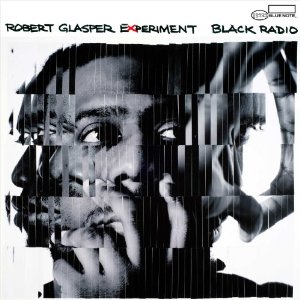 After listening to so much smooth vocals and jazz musicianship, I felt the need to get into something a little funkier. So I put on The Robert Glasper Experiment’s Black Radio[Blue Note Records]. Now I know that Robert Glasper is essentially a jazz musician, but apparently there’s a part of him that wants to dwell in the Soul/Funk realm, and that’s how we have The Robert Glasper Experiment. The disc opens with “Lift Off,” which borrows heavily from some of the old George Clinton/Parliament songs of the 70’s, like the classic “P-Funk (Wants to Get Funked Up),” so the music is rich with bass and features the smooth baritone voice of Shafiq Husayn narrating what is about to unfold on the rest of the album. And what unfolds is a brilliant fusion of Jazz, Soul, R&B, Rap, Funk and even a bit of Grunge Rock in the form of a cover of Nirvana’s “Smells Like Teen Spirit.” One of my favorite tracks is Erykah Badu’s reimagining of the Mongo Santamaria classic, “Afro Blue.” No matter the material, the Jones amps get the most from each recording by rendering finely etched instruments and voices, bringing the performances to life in your listening room. They not only get out of the way of the music by not imparting any sonic characteristics of their own, but they don’t allow any other sonic artifacts to loom either. These may be the quietest high-powered amps I’ve heard in my home.
Conclusion
I’ve been very fortunate over the past twelve months to have spent a lot of time with some great amps, beginning with the Classé CA-M600s, then the Behold Gentle and Vitus Audio RI-100 integrateds, and now the Jones Audio PA-M300 Series 2 mono amps. The obvious comparison for the Joneses would be the Classé monos. In terms of musicality, I’d give the slight nod to the Jones amps for the shocking level of sharpness they bring to the recordings. And as nicely constructed as the Classés are, the Jones amps would look right at home in an art gallery. But it must also be noted that the Classé amps are about $10k less than the Jones amps and that’s nothing to sneeze at in this economy. And when you consider that the excellent Classé CP-800 preamp costs only $5k, that means you can have the Classé combo for $5k less than the Jones monos alone. Unfortunately, I didn’t have the Jones preamp on hand so the comparison ends here.
But hey, this is the world of high-end audio and economic variables simply don’t carry the weight of emotional ones. Besides, I saw enough things at CES to know that you can spend a lot more money and get a lot less in return. Having said that, few amps I’ve encountered have stirred the emotions the way that the Jones amps did. I’m not sure how you put an economic value on that.


Specifications
Jones Audio PA-M300 Mono Amps
Power: 300 watts into 8 ohms
560 watts into 4 ohms
Transformer: Ultra-low-noise, shielded 1000 VA
Universal 50/60 hz
Power Consumption: 775 watts
Power Requirements: 120 volt and 240 volt available
Class of Operation: A/AB
Frequency Response: 10hz-200Khz (+0,-1dB)
Thd+N: SNR: -119 db (A-weighted)
IMD:
Dimensions: 8.2″ (H) x 16.2″ (W) x 16.3″ (D)
Weight: 80 lbs
Price: $24,000.00/pair
Address:
Jones Audio
30741 Third Ave.
Suite 160
Black Diamond, WA 98010
Phone: 360.886.0890
Fax: 360.886.8922
Email: info@jones-audio.com
Website: http://www.jones-audio.com/

 Don’t forget to bookmark us! (CTRL-SHFT-D)


Stereo Times Masthead
Publisher/Founder
Clement Perry
Editor
Dave Thomas
Senior Editors
Frank Alles, Mike Girardi, Russell Lichter, Terry London, Moreno Mitchell, Paul Szabady, Bill Wells, Mike Wright, and Stephen Yan,
Current Contributors
David Abramson, Tim Barrall, Dave Allison, Ron Cook, Lewis Dardick, John Hoffman, Dan Secula, Don Shaulis, Greg Simmons, Eric Teh, Greg Voth, Richard Willie, Ed Van Winkle, Rob Dockery, Richard Doron, and Daveed Turek
Site Management Clement Perry
Ad Designer: Martin Perry
Be the first to comment on: Jones Audio PA-M300 Series 2 Mono Amps