

Aardvark The Link Review by Ron Cook
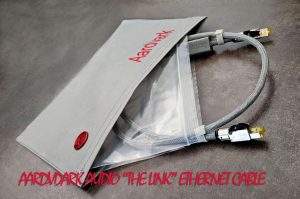
 The following is a direct quote from the Website of the Aardvark manufacturer: “…noise is the fiercest enemy of the most enjoyable aspects of music reproduction. Micro dynamics, sense of space, detail, atmosphere…sheer delight. Name those subtle features in music that open your personal door to pleasure, and noise affects them all. From the dawn of its existence, noise has been an enemy of hi-fi.
Today in the Digital Era, noise has become “The” enemy. It’s hard to dispute any of the above. Indeed, since most of us use digital sources to some extent (some now exclusively), noise impacts our listening whether we realize it or not. I would also say that most of my listening these days is on Qobuz via the Memory Player, which is why I started using the original Aardvark Classic after I reviewed it in Stereo Times a few years ago. In that review, I stated that “The function of the Aardvark is quite simple – to eliminate noise from the Ethernet line so that you hear more of the music.”
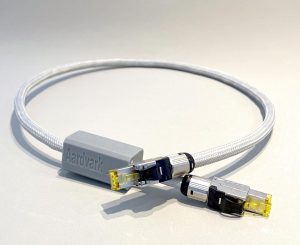
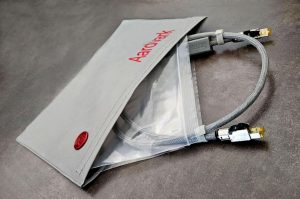
This remains the goal of Eduardo Cabrall, the developer/manufacturer of Aardvark products, who has taken the technology to another level with The Link. The goal was to significantly improve listening compared to the original Aardvark Classic by eliminating a “weak link in the chain”: the standard (and evidently noise-producing) Ethernet cable. The Aardvark Classic had both male and female connectors. The male connector inserted into the Memory Player, and the Ethernet cable from the wall socket then inserted into the female end.
 This arrangement produced notable improvements in the sound of streamed audio, as were detailed at length in my original review. The Link takes these improvements a step further by eliminating the need for a standard Ethernet cable. With male connectors on both ends, The Link plugs into the wall socket and the other end directly into the Memory Player, a simple yet elegant solution. The result is that all the improvements made by the original Aardvark Classic (increased air and soundstage, better imaging, more purity of tonal colors, etc.) are now taken to a higher level. Another especially noticeable improvement was a dramatic increase in dynamics and flow. It’s difficult for me to describe this sonically so that an analogy might help. Imagine the difference in flow between filling a swimming pool with a garden hose attached to a household faucet and using a firefighter’s hose hooked up to a fire hydrant. In terms of sonic flow, The Link lets music burst forth effortlessly from a dead-silent background, creating an enormous, enveloping soundstage. At the same time, everything sounds much more real. Subtle, intricate details come through effortlessly, yet the sound is never harsh or fatiguing, no matter what volume level you choose.
As I stated in my original review of the Aardvark Classic (reviewed here) …..” If you want to read the manufacturer’s comments about how he has addressed the noise issue, please go to http://aardvark.com.ar. Since I admit that I am not a technical guy (especially when it comes to digital), I will confine my comments to what I hear rather than how it’s done.”
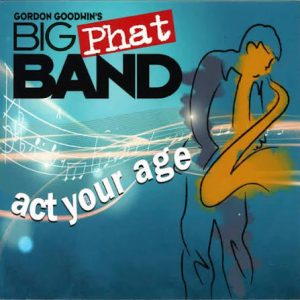 This remains true today, and here are examples of what I hear when using The Link in my system: One automatic go-to choice I use to evaluate my system’s performance is the track Backrow Politics from the album Act Your Age by the Gordon Goodwin Big Phat Band. This is an exceptional big-band jazz recording, and listening to it through The Link has raised the bar to another level of enjoyment. The sheer scale of the band is even more evident, with precise placement of each horn section in the soundstage’s increased spaciousness. Saxophones are to the right, trombones to the left, and trumpets higher above and recessed behind the other horns, as they would be on stage in an actual performance. This wonderful soundstage would be wasted if the instruments themselves didn’t sound “right,” but fear not, they sound as close to real as I’ve ever encountered. The trumpets are sweet, yet have the “bite” they have in real life. Likewise, the other instruments all have lifelike color, timbre, and tonal density. Percussion sounds are also excellent. For example, the drummer’s kick drum goes into high gear at the end of the section where the trumpets trade their terrific short solos. The increased articulation lets each quick kick be heard distinctly, rather than blending into a sonic blur.
Paul Simon’s Graceland features vocal performances by the male choral group Ladysmith Black Mambazo, and they, along with Simon, open the track “Diamonds On The Soles of Her Shoes.” The quiet yet reverberant background produced by The Link lets you virtually count the voices floating in space across my “room without walls” and extending well beyond the speakers. At the same time, Paul’s voice is clear, clean, and laser-focused in the center with just the right amount of sibilance. As the instruments join in, they are rendered in their own spaces with wonderful tonal focus and color. Overall, an incredible illusion and a great performance!
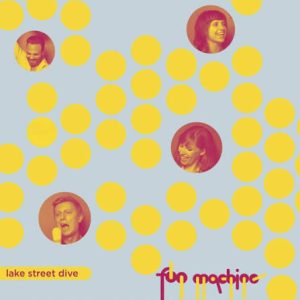 Though they were formed in 2004, I’ve only recently discovered the band Lake Street Dive. One track I particularly enjoy is Let Me Roll It, from their album “Fun Machine.” This is a cover of the original song, which was written and performed by Paul McCartney & Wings on his 1973 album Band On The Run. On this track, Rachael Price sings lead vocals, with excellent backing harmonies from the other band members. Her voice is beautifully centered on a very wide soundstage. The well-known guitar lick from Paul’s album is here played by an extremely well-recorded trumpet player, Mike “McDuck Olson, who “appears” standing three or four feet to the right of the right channel speaker (a very “spooky” illusion). The bass guitar is low and powerful and, along with tasteful drumming, gives the track a solid rhythm and drive. Without extraneous noise, live performances can sound particularly realistic.
Take, for example, the track Sittin On The Dock Of The Bay from Sara Bareilles’ album “Brave Enough: Live at the Variety Playhouse.” This track not only features an exceptional recording of her voice and piano, but also captures the ambient sound of the performance venue and audience. Listen to this late at night with the lights out, and it’s a very strong “you are there” experience. Another exceptional live studio performance that captures acoustic instruments beautifully is on the album “Feel Like Making LIVE.” Recorded by The Bob James Trio, the album features Bob James on piano, Michael Palazzolo on bass, and Billy Kilson on drums. Sonically, I don’t think I’ve yet heard a better recording of a jazz trio. It is a pleasure to hear a performance by such talent that is recorded realistically, i.e., each instrument sounding completely natural in its own realistic-sized space rather than spread across the entire soundstage in a jumbled sonic mess.
As a drummer myself, I find it particularly satisfying to hear a realistic drum sound, which is what I hear on this recording. On the track Rocket Man, the click produced when the drummer holds the stick across the snare drum head and over the rim while gently tapping is so clearly rendered that I can pretty much discern the size and weight of the stick he used! Listening to the track Misty, you get masterful performances and beautiful sonics. A simply gorgeous piano sound is perfectly supported by a tuneful, full-bodied upright bass and ultra-crisp brushwork on the snare drum. Again, as a drummer, I am very fussy about the sound of cymbals on a recording. They should be clean and clear, but never harsh. With The Link in my system, that harshness is a thing of the past, and the cymbal sounds in this recording are quite beautiful.
 Finally, check out the jazz/funk track Nautilus, where the phenomenal sonics let you enjoy a truly awesome performance! From the examples I’ve given, it is clear to me that removing noise doesn’t favor any one genre of music. From the deepest bass and thunder of electronica to acoustic jazz; from pop to classical vocals; from the scale of a full symphony orchestra to the delicacy of a solo violin, EVERYTHING sounds that much better and more like the real thing. A few friends recently visited, listened to my system after not hearing it for some time, and listened to a variety of music genres. One of them summed up their reactions to this “new” sound quite succinctly by saying, “What you’ve got going here is really amazing. The sound is top-notch, beautiful, and truly enveloping, and your walls have disappeared.” Of course, he was also describing the illusion that is, in part, due to having the Bacch in the system. That said, the wondrous effect of the BACCH would definitely be lessened without the dramatic noise reduction that The Link provides. This is true sonic synergism at work! Conclusion: Bottom line – the Aardvark devices have allowed me to enjoy streaming music through my Memory Player as much as (if not more than) any of my other sources of recorded music. Indeed, with access to so much variety, I have discovered the pleasure of listening to music I otherwise would never have experienced. For that reason and for me at this point, Aardvark’s The Link is simply indispensable in my system. As to the price of The Link, I, like many, will always question the cost/benefit of any upgrade. In this instance, considering the gain in performance of my system with absolutely no downside, and given the cost of other elements of the high end in today’s world, I consider The Link as well as the other Aardvark products to be true bargains!

Specifications:
Price: $1,899
Website: aardvark.com.ar
USA Distributor: Liquid Hi-Fi, Charlotte, NC area
Ron Cook’s associated equipment:
System Digital: Laufer Teknik Memory Player 64
Analog: VPI Aires TT, JMW Memorial tonearm, Benz Micro Ruby 2 cartridge, Behold phono stage
Amplification: Behold BPA-768 amplifier and APU-768 pre-amplifier. Loudspeakers: Tekton Design Ulfberht 15
Speaker Cables: Laufer Teknik Soliton
Accessories and Tweaks: Theoretica BACCH 4MacPro, Puritan line conditioner, Grand Activation Extreme, HGA-600 AC Cords, Kemp M100 AC conditioner, Frank Acoustics Power Bank, IPC Acoustic Energizers, HighEnd Novum PMR, Argent Room Lenses, Bybee IQSEs, Purifiers & V2S, QSA Silver and Red/black fuses, QSA electrical outlets, Aardvark – The Link



Stereo Times Masthead
Publisher/Founder
Clement Perry
Editor
Dave Thomas
Senior Editors
Frank Alles, Mike Girardi, Russell Lichter, Terry London, Moreno Mitchell, Paul Szabady, Bill Wells, Mike Wright, and Stephen Yan,
Current Contributors
David Abramson, Tim Barrall, Dave Allison, Ron Cook, Lewis Dardick, John Hoffman, Dan Secula, Don Shaulis, Greg Simmons, Eric Teh, Greg Voth, Richard Willie, Ed Van Winkle, Rob Dockery, Richard Doron, and Daveed Turek
Site Management Clement Perry
Ad Designer: Martin Perry
Be the first to comment on: Aardvark The Link Review by Ron Cook