

DAAD (Diffusion Absorption Acoustic Devices)
| DAAD (Diffusion Absorption Acoustic Devices) |
| Building “Acropolis” at home and how I learnt a lesson |
|
|
|
April 2007 |
Like most audiophiles who’ve been in this hobby for many years, I’ve tried a lot of equipment. From vintage tube gear from Dynaco and C-J to solid-state electronics from NAD, Tandberg, Krell, Nakamichi, EC, etc. I have owned large Infinity speakers, small Dynaudios, Proacs, various Peak-Consults, etc. I have also changed more cables than I am willing to admit, believe me.
All these years, my focus has been on the equipment and on investing money where I thought it made the greatest impact on the sound. What I have learned is that the sound changes every time I swap gear, but that change wasn’t always better. But of course, my system at present communicates the music on a high level and before my journey into the mysteries of acoustic room treatment began I was very pleased with the sound.
After redecorating my house and my listening room this winter, I thought it was time to “get the job done” and make the final investments in the system. Therefore, I started reading about room acoustics online and in magazines. Previously, I have taken shortcuts, as I am sure many others have, when it comes to room acoustics. Carpets, drapes, pillows, plants, etc. I’m not saying that such devices can’t improve the sound. They may help, but nothing can replace good theory and well-crafted products. I can say this now because I know. There are no cheap ways to get really good sound at home in general, and room acoustics are no exception to that rule.
This review would not have been possible without the Norwegian importer Base-Technology’s efforts. That said, I have to confess that this was a difficult review to write. One reason was that the sound changed every time I made any adjustments. Not much, but enough that I had to concentrate and keep playing the same cuts over and over again to verify my findings.
Another issue here was the theory behind the products, most of which were new to me. Yes, I have heard about echoes, standing waves, etc., but never really bothered to investigate them further. I feel like a fool now for not having taken the time to learn more about acoustics earlier. Well, it’s never too late.
When I contacted the importer the first time, he asked me for a drawing of my listening room. This is standard procedure at Acoustica Applicata, and what I got back from them really showed me they are serious about what they do. I got three drawings, each from a different angle, with placement recommendations and indications of the speakers’ reflective patterns. Let me say this at once: what they recommended proved to be very close to the perfect placement in my room. Even the angle at which to point the reflective and absorbing (it is marked on the DAAD`s) sides was right. Not bad, given that all this was based on my primitive drawing. So, trust these people; you are in good hands.
The DAADs (Diffusion Absorption Acoustic Devices) have a wooden plate on the top and bottom, and their fit-n-finish is very good. They come in three different colors (white, grey, and black) and sizes:
The DAAD 2™ is for resonances at 120Hz and over, and for early lateral and back reflections.
The DAAD3™ is for resonances at 70Hz and over, and for all kinds of early reflections.
Finally, the DAAD4™ is for resonances at 50Hz and over, and for early anterior reflections.
On their website, I found a very enjoyable article about how these Italian enthusiasts created the DAAD products. The following text is taken directly from this article. I mean, who could better describe their theory and products than themselves?
“In order to get what we wanted, we had to experiment with other materials and thicknesses that allowed air to penetrate the trap quickly and get out again after a given time. These new materials shouldn’t create excessive friction to the air passing through them, in order not to slow down the functioning of the entire acoustic device with regard to the timing of music transients that follow each other. What we wanted was a ‘fast’ trap!
After some substantial additional research, we finally found a satisfactory combination of two materials. At that point (we were in 1998), we had found two important ingredients: the micro-pressed reticulate for the cover grille and an interesting combination of materials for the resistive layer inside. Apart from being extremely interesting from an acoustic point of view, these two materials offered other important practical advantages. The micro-pressed metal sheet looks better and is easier to clean than the cloth covering Tube Traps. The new resistive material inside doesn’t dust and, therefore, doesn’t need to be wrapped in a protective mantle like glass wool in Tube Traps. All we had to do now was define the final shape of our new acoustic device.
The shape of a lobe seemed the most suitable one, for the following reasons:
“The shape of a lobe seemed the most suitable one, for the following reasons:
1. Its internal volume being equal to a cylinder, a lobe-shaped device ‘penetrates’ the corners of a room more deeply, thus capturing the resounding frequencies more easily;
2. Its shape facilitates the simultaneous use of different materials for the resistive layer of the device;
3. Like a cylinder, but unlike a flat panel, a lobe device allows one to have an inner volume with air and a thickness able to create ‘acoustic shade’. In other words, it provides a very good ratio between the space used and the results achieved.
4. Like a cylinder, but unlike a flat panel, a lobe device can be rotated on itself. Having lobes with different diffusion characteristics allows one to position them in several ways and to change room acoustics according to one’s personal needs or tastes”.
All we had to do now was to find the correct ratio between the thickness of the resistive material and the degree of ‘permeability’ to air of the pressed metal sheet. Listening tests and further changes to our prototypes followed each other at a very fast pace. We focused mainly on some specific issues: the quality of the reproduced voice, which had to be open and transparent, without halos (and here the rendering of vowels was particularly important); the sensation of air, freedom, the opening of the soundstage; the lack of boomy low frequencies and of muddy sound in the heat zone (100-300 Hz)”.
If you are interested, you can read the whole article here:
Building Acropolis at home

I have a dedicated listening room and can really do what I want in it. And that’s a good thing because setting up a lot of DAADs in a room certainly makes a visual impact. That said, they blended very well into the room, though I still wasn’t sure I really wanted this kind of product in my living room. Well, let me be honest with you: My wife would not allow it either!
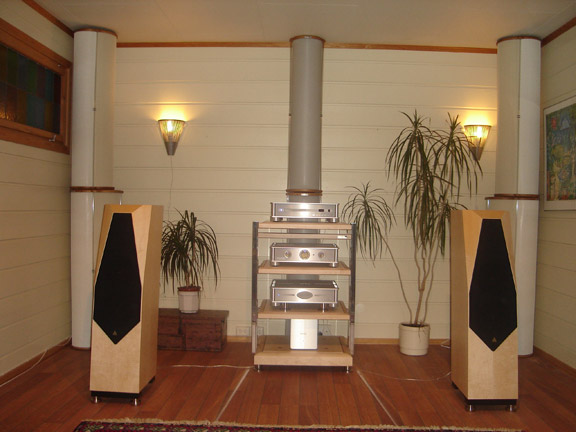
My room is about 5.5 meters long and 4.5 meters wide. The ceiling is 2.3 high. I have a massive wooden floor with a large oriental carpet in front of the system. The walls are made of wood, and the only furniture I have is my listening chair, a CD rack, and some low bookshelves. I have some plants behind the speakers for decoration.
The ideal listening room needs a touch of reverb to prevent the room from sounding unnaturally dead. I know. I have experienced this once with an overdose of acoustic treatment in combination with heavy wall-to-wall carpet. The sound was absolutely lifeless. Keep in mind that all things acoustical must be handled with expert help. By all means, try it for yourself, but do not expect a miracle.
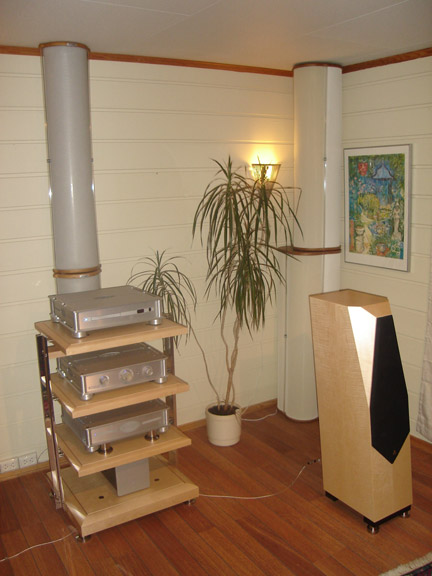 The importer brought eight DAADs to my house. We followed the instructions given to us by the manufacturer, and the result was visually somewhat “Acropolistic.” In the corners, behind the speakers, one DAAD 3 was stacked on top of a DAAD 4 and reached from the floor to the ceiling. On both sides of the rack, we placed one DAAD 2 and two DAAD 2s directly behind the rack, again from the floor to the ceiling. Remember that this is by no means a complete treatment. For that, you also need to treat the sides of the room and, of course, the area behind the listening position. With a complete treatment, I expect the results to be even better than what I got in my room during the review period. I will try to do a follow-up later. But if you can afford (and can live with) the full package, go ahead!
The lesson
The first thing I noticed when we finished the setup and fine-tuning was that human voices sounded much more natural and soft. This was clear right from the outset when I talked to the importer who helped me with the installation. Being unaware of my acoustical problems, I was really surprised. I thought my room was ok (but by no means perfect) because it’s rectangular, has some angles, a big carpet on the floor, plants, and so on. Well, I was wrong and somewhat naive. Echoes, bass issues, standing waves and a somewhat uneven balance proved to be areas where the most significant challenges were.
When I started playing music, it was amazing how the soundstage got broader and deeper, the highs became more extended and natural, and the bass became fuller and better defined. Much better, that is. With the DAADs in place, the bass had terrific extension; it was tighter and more controlled throughout the entire bass range and as transparent, articulate, and quick as I’ve ever heard in my room.
The midrange was more natural and transparent than ever before. Not too much, not too little, just right. Everything was delivered with a particular neutrality and ease. Voices, speaking, and singing were also improved. Some female voices can be very intense. With the DAADs installed, voices were still very present but better sounding, with no rough edges. The sound of a piano when played hard and loud was much better because of the improved room acoustics. All in all, everything sounded more convincing than before. And that is what we aim for, right? The amazing thing was that I got improved sound across the entire frequency range.
As I said at the beginning of this story, the manufacturer’s advice was spot on. I tried turning the DAADs just a few degrees left or right, lifting them off the floor, and trying different locations. I always ended up as I started.
With all the DAADs I had on hand in the room, the improvement in the sound was very easy to hear with all kinds of music, no need to bother you with any more “audiophile jargons”, you know them too well. So, I realized that I had to buy some myself, but I did not want the full package. The next project was to find the fewest DAADs needed to achieve a significant improvement in sound without having to fill the room. And to drain my bank account completely. It has suffered enough over the last few years.
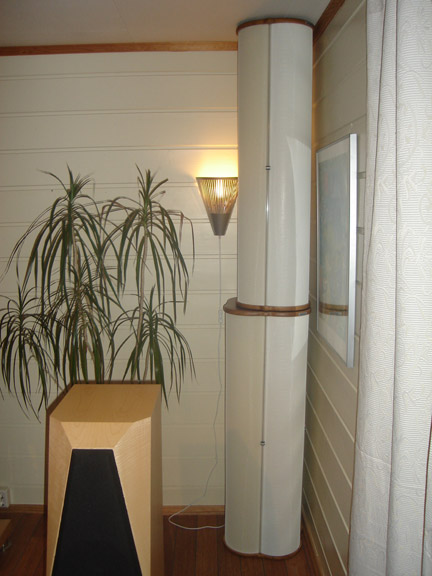 Therefore, app. 2 weeks into the review period, I started experimenting with placements and reducing DAADs. The question was this: Do you have to buy the full package, or can improvements in room acoustics also be had by a smaller number of columns? The answer is, fortunately, yes, you can. To see what was possible with a smaller investment, I removed 2 of the DAAD 3s I had on top of the no. 4 in the corners behind the speakers. Then I removed one of the DAAD 2s I had behind my rack, and both DAAD 2s that stood against the back wall.
Now I had (and still have!) the following: One DAAD 3 in each corner behind the speakers, one DAAD 2 directly behind the rack, and one DAAD 2 on the left wall to deal with early reflections. On the right side of the system, I have large drapes, so the DAAD 2 on the left side helps to balance the sound and stabilize the soundstage.
I came to this setup after I had carried DAADs in and out of the listening room for hours, playing the same three pieces of music. Interesting it may have been, but, boy, was I happy when I finally reached the result. With this “light” setup, I got about 80% of the performance for 50% of the price. I got improvements all over, but of course, to a somewhat lesser degree. It is with audio as it is in life; you have to compromise. I found a solution that works well in my room at present. Maybe I will take it to the next level later on.
This experience tells me that it is crucial to have an open mind about all things in audio. Never take it for granted that you have got the most out of your system before you (within your limits) have tried different options. Every audiophile who invests time and money into a system MUST treat the room properly; it is that simple.
“Every listening room should have some”.
The DAADs are great tools for the fine-tuning of a system. Unlike what happens when you change electronics, these products really make the sound better, not just different. Be humble enough to let the experts (in this case, from Acoustica Applicata) help you make your system sound better. I feel I have squeezed out what I can from my system as it is now, and that is a good feeling. These products are highly addictive. Consider yourself warned!
Jan Petter Egidius
__________________
Manufacturer info:
Acustica Applicata
Via Roma, 79 – 55027
Gallicano (LUCCA -ITALY)
Tel. +39 0583 730322
Fax +39 0583 730914
E-mail info@acusticaapplicata.com
Website www.acusticaapplicata.com
Norwegian importer:
Nordic Sound Design
Norway
Website www.base-technology.com

 Don’t forget to bookmark us! (CTRL-SHFT-D)
One thought on "DAAD (Diffusion Absorption Acoustic Devices)"
Leave a Reply



Stereo Times Masthead
Publisher/Founder
Clement Perry
Editor
Dave Thomas
Senior Editors
Frank Alles, Mike Girardi, Russell Lichter, Terry London, Moreno Mitchell, Paul Szabady, Bill Wells, Mike Wright, and Stephen Yan,
Current Contributors
David Abramson, Tim Barrall, Dave Allison, Ron Cook, Lewis Dardick, John Hoffman, Dan Secula, Don Shaulis, Greg Simmons, Eric Teh, Greg Voth, Richard Willie, Ed Van Winkle, Rob Dockery, Richard Doron, and Daveed Turek
Site Management Clement Perry
Ad Designer: Martin Perry
Great review. I have been using synergistic research HFTs that significantly improved bass definition, soundstaging & imaging, as well as increasing midrange clarity & presence. More natural, realistic & fast.
I recently bought 2nd hand GIK acoustic panels & then did my own research on room acoustics.
As hifi systems improve, eg, upgrades, tweaks, bass quality & quantity increases, which means more bass energy? Bass is omnidirectional, but the bass drivers are pointing to the listener. If we have bass absorption/diffusers at first reflections, i.e. top, bottom, & sides, would this eliminate 80% of the problem? Everyone who listens to music should have a big chunky foot stool! 😊
Even if speakers are full enclosures, low frequency vibrations from the cabinets will occur. Higher the volume, the more vibrations? One analogy is a stone thrown in a lake, creating ripples. Likewise, just using spikes under speakers means vibrations are never removed, eg, less defined, blurred imaging, less detail. This indicates that ground, speaker, & room vibrations will continue to interact with each other.
Some top recording studio side walls seem to focus on diffusers more, i.e. 1st reflection, with large absorbers on the back & front walls. The 1st reflection diffusers probably scatter the bass frequencies, mostly to the left & right. Some will scatter up & down between speakers & listener. While 1st reflection ceiling absorbers will remove say 80% of bass frequencies, we still have 20% bouncing around, but will disappear in milliseconds.
In terms of solutions to room problems, there are probably over 100 ways to produce the same outcome. The sooner we can absorb the bass frequencies, the less likely we need more absorbers, eg, corners. 1st reflection points & behind speakers is probably a good place to start. Bass frequencies don’t get trapped in corners & will be absorbed by curtains, sofas, carpets, clothes.
A clean noise free power supply, choosing one of the three top best speaker supports & equipment supports on the market today, & either buying or making sound panels, will dramatically improve the sound of your system. How many panels(6 so far + 13 SR HFTs) & where to place to them is down to trial & error. I think I will probably buy two more polycyclindrical diffusers/absorbers to fine tune my room. These could be the ones I choose.