

The Bel Canto EVo 200.2 Amplifier
| The Creature that Rose from Beneath the Planet of the Son of “Tube Fest” |
| Stuart McCreary & Clement Perry |
| 23 October 2000 |
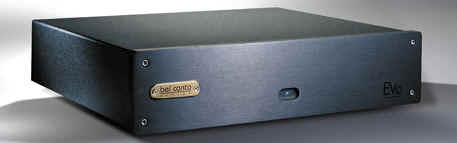 Specifications
EVo 200.2 Class T Digital Amplifier
Frequency Response: 1Hz – 80KHz
Continuous RMS Power per Channel
1% THD + N: 120W 8 Ohms, 240W 4 Ohms
Inputs: XLR & RCA
Weight: 30 lbs. Dimensions 4 by 15.5 by 17″
Price: $2,395
Bel Canto Design, Ltd.
212 3rd Avenue North,
Ste 345
Minneapolis, MN
55401 USA
Tel: 612.317.4550
Web: http://www.belcantodesign.com/
I know what Martin Luther must have felt like when he challenged the infallibility of the Pope, or when that cocky upstart, Copernicus, spilled the beans that the planets circled the Sun. OK….so, maybe we audio pundits take ourselves, and this hobby, a little too seriously, but in the context of our little audio world and the dogmas that we cling to with religious fervor, I’m about to take a stand that some of my audio brethren will call heretical.
I’ve set myself up for this. Like a good zealot, I began my pilgrimage into the world of tube amps with great hope and enthusiasm. I called my little odyssey “Tube Fest,” for lack of a better name, and proceeded to evaluate in my personal listening temple over 25 tube amps of every topology imaginable – single ended, push-pull, hybrids, OTL’s, parallel single-ended, differential single-ended, 300B’s, 811’s, 845’s, EL 34’s, 6550’s…. on and on ad infinitum. And lest you think that I jumped into tubes for the wrong reason, I should add that a good deal of my motivation came from the dissatisfaction wrought by years of experimenting with a host of solid-state amps.
This was all done in a two-year time period, which brought new meaning to the words “audio burn-out.” I actually stopped counting after 25 because, quite frankly, it was getting ridiculous. I couldn’t possibly review all of them and do amplifiers, or their manufacturers, justice. So it became an obsession of purely selfish motives. I just wanted to find my personal magic, the one that would become “IT.” I had no sense of altruism, no sense of helping my fellow ‘phile. You see, in my quest for the “Holy Grail” of amplifiers, I learned that it was MY quest and MY Grail. To think that anyone else was really along for the ride, or even cared, somehow cheapened the experience—made it less solitary, less arduous, and therefore less cleansing of the soul. After all, isn’t that what a pilgrimage is supposed to be?
Well, the upshot of all this nonsense, was a major case of burnout and an a malaise that lasted two full years. My good friend, spiritual confidant, and editor in chief at PF, Dave Robinson, wondered if I would ever write another installment of “Stu’s Place.” I wondered too, but thankfully, some really amazing products got me out of my funk faster than a Prozac cocktail. One of the first, and most powerful mood-altering products to land at Stu’s Place is the subject of this review—the Bel Canto, EVo 200.2 amplifier.
Let’s get the heresy over with right now. A solid state “digital” amplifier that weighs less than the Bright Star Little Rock that sits on it and runs as cool as the Black Diamond cones it rests on, has three dimensional imaging, timbral accuracy, midrange texture, micro dynamics and decay as good as, no, better than any tube or hybrid amplifier I’ve heard. I don’t come to this conclusion lightly. I know all too well that these are the very areas where tube amplifiers often excel over their solid-state kin. These are the very performance characteristics that got me hooked on tubes in the first place.
So go ahead, sick the tube gods on me. Throw your stones at the heretic that dares claim that a solid state amp, let alone a “digital” one, out-images, and well …. “out tubes,” in the best sense of the word, an SE triode amp.
But before you cast your first stone, think about something for a minute. Do you think a company that made its living on SE triode amps (and has some damn fine ones, I might add) could tell when they had something that cleaned their own clocks? Do you think they would have the guts to admit it, even tout it, given the fervor of the SE triode crowd?
Well, guess what, buckos…..THEY DID!
Ah, hah!…stopped your arm in mid-throw, didn’t I.
Testify with Technology
My conversations with engineer-designer John Stonzcer were most enlightening. When I asked him if he thought the EVo outperformed Bel Canto’s SET 40 and SET 80 amps, his response was simply, “of course.” By his estimation, it took all of about 30 seconds of listening to know that the EVo was “where all future amplification is headed.” Very unequivocal for a guy who has labored long to get the most from SET amplifiers. Come to think of it, given John’s engineering background, perhaps he was uniquely qualified to appreciate the merits of the latest in digital amplification.
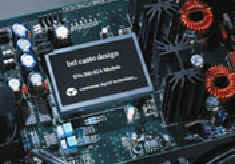 John’s primary area of work and expertise is in the telecommunications industry, where dealing with digital circuits operating in the gigahertz range is an everyday occurrence. He apparently had the good sense and fortune to be one of the first high-end audio engineers to work with the amazing digital amplification modules from Tripath Technology.
Tripath Module
Tripath has come up with a digital audio amplifier that they refer to as Class-T amplification. This designation is used to distinguish this new system from pulse-width modulated switching amplifiers (Class-D), which gave us our first real taste of high-end digital amplification. The Spectron, “Musician” amplifier that I had the pleasure of hearing in my room a few years ago is a fine example of a pure Class-D amplifier.
Class-T provides power conversion efficiencies of 80 percent or more than 90 percent, which is equal to or better than Class-D amplifiers. Compare this to conventional linear amplifiers that are only 40-50% efficient.
Tripath acknowledges that Class-D has some of the same advantages as their Class-T amplifier, but claims Class-D can not achieve them without a significant compromise in audio fidelity. This gets a little rough, technically speaking, so I’ll borrow some of the material that appears on Tripath’s white paper:
“Tripath Class-T technology uses both analog circuitry and Tripath’s Digital Power Processing algorithms that modulate the input signal with a high-frequency switching pattern. Tripath’s proprietary algorithms are derivatives of adaptive and predictive algorithms used in telecommunications processors. The modulated signal is sent to output transistors then through a low-pass filter (external to the Tripath amplifier) that demodulates it to recover an amplified version of the audio input.
In a Tripath amplifier there is an input stage that provides analog input signal buffering. The output of this stage drives the Digital Power Processing TM block. This block contains an adaptive signal conditioning processor, a digital conversion function, mute control, overload handling, fault detection, predictive processing and qualification logic functions. The output of the DPP TM block controls a power output stage that drives a speaker through an output filter.
Instead of using Pulse Width Modulation (“PWM”), Tripath Class-T amplifier processors use proprietary algorithms and techniques to create the modulation that drives the switching transistors. A Class-T amplifier’s processors learn the characteristics of the output transistors. Then, based on the analog input signal, they switch the output transistors with exactly the right timing to eliminate Class-D PWM problems: transistors not being perfect switches, ground bounce, output transistor mismatches, dead-time distortion and residual energy from the oscillator in the audio band. The result is a high power efficiency, audiophile-quality audio amplifier – a Class-T amplifier.
If one were to compare the waveform before the output filter of a Class-D PWM amplifier to a Tripath Class-T amplifier, some significant differences would be evident. The waveform for a Class-D PWM amplifier would be a pulse-width varying digital signal at the fixed, 100-200kHz, frequency of the triangle wave generator. The waveform for a Tripath Class-T amplifier would be a complex digital waveform of varying frequency. A Class-T amplifier switches the output transistors in a fashion similar to spread spectrum technology, at a varying rate up to 1.5 MHz and averages 600kHz to 700kHz.”
The adaptive processing that goes on inside the Tripath module is truly cutting edge. There are eight patents on this technology and apparently, still others pending.
The Class-T design has some obvious advantages over Class-D that should be audible. I do have some experience with Class-D amplifiers. Well, only one actually — the original Spectron “Musician” amplifier. This amp received a rave from Positive Feedback’s technical editor Mike Pappas. I, too, was able to check out a demo unit after it had made the rounds. I couldn’t fault Mike for falling so hard for the Spectron. It was an extraordinary amplifier. I was very impressed with it, especially my initial impressions. It had real dynamic power and presented a surprisingly exact, almost “Technicolor” soundstage.
My longer-term impressions weren’t as uniformly positive. The Technicolor thing started to get to me. It had amazing image focus on the lateral plane, but fell short in the depth department. This made for an “oh wow”…2-D exactness, but not the 3-D natural presentation that gives me goosebumps. There was, regrettably, a persistent artificiality to it — sort of a clinical coldness (in the emotional sense, not the tonal) that kept reinforcing in my mind the fact that it was a “digital” amplifier.
I came away from the experience thinking that digital amplification had great promise. Indeed, it does, and I believe that promise is fulfilled with the EVo’s implementation of Class-T digital.
The real question for us audiophiles, and especially us tube freaks, is — “does Class-T have any technical advantages over linear amplifiers that translate into better sound?”
Bel Canto’s John Stronczer thinks so. His white paper on the EVo states:
“The EVo digital amplifier avoids the typical large signal analog errors and crossover distortion annoyances that have plagued traditional linear power amplifiers. All analog signal processing occurs at small signal levels augmented by sophisticated DSP algorithms. To ensure low out-of-band digital energy, proprietary DSP algorithms compensate for output switch imperfections and provide controlled overload and clipping characteristics. The DSP engine clearly delivers superior performance – beyond any previous technologies.”
So much for the amplification stage. What about the output?
“The elegant design of the power stage uses only two high-current N-channel output devices. This digital output stage completely eliminates the matching and bias problems found in traditional linear amplifiers. The result is cool-running, stable operation that you hear as steady imaging and solid, dynamic bass performance. Compared with push-pull solid state or tube class AB amplifiers, the EVo 200.2 is designed with fewer small signal distortion mechanisms to overcome. Even without relying on traditional analog feedback mechanisms, the EVo 200.2 produces less than 0.05% harmonic and inter-modulation distortion.”
Sounds like John believes there are advantages there, too.
I know what you inveterate tweakers are thinking. You’re thinking that you can pick up one of the test modules from Tripath, slap it into a metal box with some RCA jacks and an off-the-shelf power supply, and bingo, you’ve got yourself a Poor Man’s EVo. As cool as that may sound, I don’t think the results would bowl you over.
It’s said God is in the details, and that certainly is true in the world of high-end audio. The Bel Canto boys acknowledge the technological tour de force of the Tripath module, but are also aware of its limitations. It’s the implementation of the module that makes the difference between good and great.
John says that the raw module can be a bit harsh, particularly for us “hollow state” aficionados. To get it to perform up to its full potential, the same care in the analog stages must be used with the Tripath module as is used in high-end analog amplifiers.
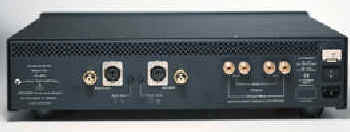
A high-quality analog power supply is used together with a sophisticated dual-zone star-grounding scheme. The input stage is instrument grade with very high-quality mil-spec resistors and an optimally short signal path, and it was designed in such a way as to obviate the need for coupling capacitors.
Because the Tri-path module operates at extremely high frequencies, there is a lot of radiated residual energy that must be addressed. The EVo uses an 80kHz LC filter to reject this energy and to optimize phase response.
I suspect that without this meticulous attention to the analog performance, you’ll have yourself a poor-sounding, Poor Man’s EVo.
I Can See Right Through You
Three words summarize my listening impressions of the EVo. In order of importance, they are: transparency, depth, and agility. The first, “transparency,” really gets to the heart and soul of the EVo. I know this word is used to death, and means different things to different people, so let me try to define it in the EVo’s context. For me, transparency is looking into the soundstage through an utterly clear window. So clear, that you may even forget for a few blissful moments that there is any window there at all. Of course, a true “no window” experience would be listening to a live performance in your room. That being impossible, we strive for the next best thing — the pristine, “just windexed,” squeegee clean window.
I hate to mix analogies or metaphors, but in this case, you’ll have to consider the visual and auditory as being one and the same. So when I say that a clear window enhances the listening experience in many ways, you can just give a sly grin and continue on like it makes perfect sense.
The clear window enables you to hear the finest details, like the reverberation off the back wall of the hall, the soft breathing of the instrumentalists, feet lightly tapping on a hardwood studio floor, and the textured sand-papery sound of wood on stretched skin.
With the EVo, there is nothing hyped or artificial about this detail. It is not the product of treble emphasis or a pushed forward midrange. It’s just there, crystal clear, like the real thing.
The antithesis of the clear window is “veiled” sound. “Veils” obscure the fine detail, like a sheer drapery allows light and images to be seen through a window, but softens and diffuses them. Veils can take many forms, some being a gray opacity or haze that permeates the entire soundstage, others being more frequency-related, resulting from a rolled-off treble or a thickened, ripe midrange, often attributed to tube circuits. Still others are due to time and phase anomalies that diffuse images and may cause them to wander. No matter what form they take, veils rob the listening experience of realism and immediacy.
The wonderful thing about the EVo is that it provides the clearest, veil-free window I have personally ever heard from an amplifier.
When I described this to John Stronzcer and asked the simple question, “why,” he said it had to be due to the EVo’s extraordinarily low distortion (actually, the EVo’s distortion levels are reported as being 10 to 100 times lower than SE triode amplifiers). Well, “duh” … of course that’s it (sometimes the obvious alludes us deep thinkers). No zero crossover distortion or ground bounce, and a DSP algorithm that corrects the imperfections in the output devices…. hmm…. sounds like low distortion to me. Obviously, what I have described as veils is really nothing more than various forms of distortion.
Before I move on from the clear window theme, let me relate one other analogy that fits the EVo to a tee. I used the “draining lake” analogy when writing about another wonderful amplifier that I actually described as my “Holy Grail” at the end of the “Tube Fest” pilgrimage. It was the Blue Circle BC-2 hybrid monoblocks that conjured up the lake analogy. What I said in that review was this:
“During my listening sessions, it was a common experience for me to detect a new sound and have to back track to confirm that it wasn’t my imagination. It was as if I were sitting on a hill gazing out over a familiar lake, when slowly the water was drained and mysterious rocks, stumps and branches began to poke up through the placid surface. It was all very natural without surreal, in-your-face detail.”
I can’t think of a better way to describe my experience with the EVo. It’s the “draining lake” analogy, plus 1. Ultra-low distortion lets some pretty fantastic stuff poke its head up out of the noise floor. But it’s not just the discreet little sonic events that are so captivating — it’s the generalized, pervasive sense of the acoustic space that is so enthralling. An almost continuous flow of subtle cues tells you about the size of the hall they’re playing in, who’s closer to the rear wall and sidewalls, and what the relative humidity is. Just kidding about the latter, but you get my point — much of what we sense as “live” resides in and around the noise/distortion floor. The more you lower that floor, the more “live mojo” comes through.
If you didn’t catch it the first time, let me repeat — this incredible low-level detail is not the product of treble emphasis, or a pushed forward midrange. The EVo does it in a very natural, relaxed way. The top end reminds me of the very best neutral and open tube amp. The midrange has the perfect combination of purity and body. There is none of that thin, bleached, dry bone midrange that often plagues solid state designs. Nor is there any of the heavy, overripe midrange that is oft attributed to classic tube designs. In my system, the midrange is perfect (really, I’m not kidding).
I have some amazingly good amplifiers here gathering dust in the “on deck” circle. When I substituted them back into the system, I was again surprised at how slow, thick, and plodding they sounded. Each one threw up one or more of those annoying veils and made me want to return to the EVo as quickly as possible.
The EVo Tuning Temple
Now, I wouldn’t be telling the whole story if I didn’t tell you a little about the supporting cast. The stock EVo is very close to my personal midrange preference, but a little “dialing in” was done with power conditioning, power cords, and the isolation system. I found that the EVo benefited greatly from good power conditioning. Running it straight into my dedicated audio outlets was a bit more grainy and thin than ideal. Using the high current outlets on my Tice, Power Block III was just the proper remedy — smooth, grain-free, and the extra body and 3-D quality that the Tice TPT treatment provides.
I ended up using Robert Lee’s Acoustic Zen, “Tsunami” cords when I ran the EVo as monoblocks. These proved to be very neutral cords and worked exceptionally well with the amazing Shunyata Viper cords I used on my Sony 777ES SACD player and my Thor TA-1000 preamp. I will be commenting on the Vipers in a later review (not so subtle hint – I think they’re in a class by themselves).
For isolation, I first set the EVo’s on Townshend Seismic sinks. This produced a much warmer sound, but the concurrent defocusing of images was not acceptable. I then tried some Black Diamond #3 cones (warmer than the #4’s) with the attached “round thingies” fitted under the chassis in a tripod configuration. This brought the stage back into sharp focus (much better than the stock feet) but was just shy of the midrange body I wanted. I finally hit the jackpot when I put some Bright Star Little Rocks on top of the EVo. The mass loading and RFI shielding these Rocks provide gave me just the right amount of warmth with spectacular 3-D focus.
My reason for mentioning the supporting cast is to make the point that subtle tuning can make a huge difference in the overall enjoyment of a product like the EVo. Even when the product is as inherently “right” as the EVo, there is still a lot that can be done to customize the sound.
How Deep is Your Love
Having beaten the “transparency” horse to death, it’s time to move on to “depth” and “agility.” These two could really be described as the results of transparency or perhaps sub-sets, but I think they are important enough to warrant some brief individual comment.
I happen to be one of those crass audiophiles that make a big deal about the depth of field I hear in the soundstage. In this case, it is particularly significant because of my past experience with the Spectron Class-D digital amplifier. The only real problem I detected with that amplifier was a lack of natural depth that created a very precise, linear 2-D soundfield. I was pleased to find that, in contrast, the Class-T EVo did depth of field extremely well. In fact, I don’t think I have ever heard better. This amplifier resolves the subtlest of cues from way back in the rear of the stage and gives you solid information all the way up to the front in very clear and precise increments.
An important part of portraying a natural depth of field is the ability of the amplifier to reproduce the decay of a note, not just in terms of slowly decreasing volume, but in terms of distance from the sound source. You should have a sense that the note is radiating out from the instrument like circular ripples expanding from a pebble’s plunge in a still pond. The very s



Stereo Times Masthead
Publisher/Founder
Clement Perry
Editor
Dave Thomas
Senior Editors
Frank Alles, Mike Girardi, Russell Lichter, Terry London, Moreno Mitchell, Paul Szabady, Bill Wells, Mike Wright, and Stephen Yan,
Current Contributors
David Abramson, Tim Barrall, Dave Allison, Ron Cook, Lewis Dardick, John Hoffman, Dan Secula, Don Shaulis, Greg Simmons, Eric Teh, Greg Voth, Richard Willie, Ed Van Winkle, Rob Dockery, Richard Doron, and Daveed Turek
Site Management Clement Perry
Ad Designer: Martin Perry
Be the first to comment on: The Bel Canto EVo 200.2 Amplifier